


One of the most interesting questions raised in the last few years has been why didn’t Minecraft become the dominant UGC platform? It had a strong modding community that Microsoft eventually turned into a fragmented platform with Marketplace partners creators, featured servers developers, and community modders.
A better question for today is how can Minecraft become the UGC powerhouse and overtake Roblox? It’s a difficult proposition to write about, Minecraft is literally the most watched game in YouTube history. Why does it need to compete with anybody? Well reader, I guarantee Microsoft thinks otherwise. With an increased focus on contribution and a pressure to deliver margin, Xbox has a game whose potential ceiling is limitless.
But it’s easier said than done. Minecraft may have a solid transmedia strategy in motion, but its efforts to create diverse revenue lines within video games have mostly fallen flat. Minecraft Dungeons 2, the latest Mojang game launch, received a 76 on Metacritic and mixed reviews on Steam. But there is a clear north star, a platform that has shown how UGC and gameplay for all ages can be combined for massive upside: Roblox.
As if fate has orchestrated the opening for a changing of the guard, Roblox is on a stumble of its own. I previously posted on LinkedIn how the amazing growth of 2025 unlocked flywheel platform multiples to reach a market cap around $97B before being repriced to roughly $34B today, near its direct listing implied valuation of $30B.
From algorithm flux causing developer backlash to the biggest developers training on Roblox before leaving to create value on other services, post direct listing Roblox is in a weakened position as its stock is down 42% in 2026. If there was ever a time to take on the UGC giant of the video game industry, now would be it.
Where Are They Now
Both Minecraft and Roblox have achieved massive scale. The main differentiator is that Roblox has, from the beginning, implicitly operated as a UGC platform first while Minecraft has operated as a game first with UGC support. Minecraft doesn’t provide Roblox-style first-party hosting, publishing, and algorithmic discovery for its creator-operated public experiences. Meanwhile, Roblox heavily monetizes and taxes their two sided marketplace, using a war chest subsidized by free cash flow and the public market.
It’ll be difficult to compare direct numbers, as Roblox has a wealth of transparency by way of being a public company while Minecraft performance is rarely broken out by Xbox. For example, one comparison we have is active users: 155M MAU for Minecraft and 123M DAU for Roblox. But that is comparing apples to apple trees. However, according to Matthew Ball’s 2024 analysis, Roblox had reached 380M MAU in 2024.
Some highlights:
Minecraft
155M monthly active users
425M+ copies sold
$500M+ gross Marketplace revenue reported in 2024
1.7B Marketplace UGC downloads reported in 2024
Roblox
123M daily active users
29B hours played in Q2 2026
$1.56B quarterly bookings
$1.7B paid to creators over the last 12 months
An interesting head-to-head comparison is YouTube total views. Minecraft exceeded 1 trillion YouTube views in 2021 while Roblox exceeded 1 trillion views in August 2025, Minecraft got there 4 years earlier. This leads me to believe engagement on one product is not the same as engagement on the other, and that reveals a branding power that Minecraft can leverage for growth.
What does Roblox’s challenger look like
Roblox is one of the most heavily studied platforms with an estimated larger ecosystem of developers and players than Steam, PSN, Nintendo Online Services, and Xbox Network. I previously wrote about Roblox in May 2025:
If Roblox is a game, it’s the most played game on the planet. If Roblox is a platform, it’s the most used dedicated gaming platform on the planet. A Roblox player has over 40 million games at their disposal. Last year, Roblox generated over $3.6 billion in revenue across 40 million+ games, most of which were created by independent teams. In an industry where GTA V, Fortnite, and Minecraft are heralded as games-as-a-platform titans, Roblox quietly became the juggernaut platform in the video game industry.


So what does a giant challenger look like? What would Minecraft need to defeat the biggest ecosystem the video game industry has ever seen?
To take on Roblox you’re going to provide more expected value to both sides than Roblox does. Developers want an expected return on investment of time, money, and effort. Players want to maximize fun from game quality and social experiences for the time they give to the platform.
Developers want to put effort into developing games for a platform, and get an expected return from those efforts. This involves both providing developers tools and services that make development the lowest time and effort required per outcome, as well as providing an understanding of why a game they launched performed the way that it did.
Developer value = Reachable players × Discovery probability × Monetization per player × Creator share − Development costs − Operating costs − User acquisition costs − Platform risk
Players, on the other hand, want to find games to play, they want those games to be high quality, and they want to have fun social experiences with their friends or strangers. The biggest friction point on these platforms is the sheer number of games available. Differentiating on discovery is the highest ceiling investment a platform can make.
Player value = Discovery match quality × Experience quality × Social value ÷ Discovery friction
The strategy is simple. Build network effects to drive a new growth phase; counter-position Roblox with structurally better economics because Minecraft creates value across Xbox, Game Pass, advertising, and other Microsoft businesses; and allow switching costs to accumulate naturally through audience, social graph, developer tooling, reputation, and operating knowledge.
Minecraft has the advantage in parental trust, lowering adoption friction and creating permission for children and parents to participate in the same ecosystem. Minecraft can also offer more developer friendly financials, as Roblox developers reportedly take home roughly 27–29 cents for every Robux purchased inside a developer’s experience ($1.00 Robux - $0.30 platform fee - $0.42 for converting Robux to cash).
Developers, the hard side
Taking lingo from “The Cold Start Problem”, the hard side of the network are the minority users who do more work, contribute more to your network, but are that much harder to acquire and retain. For Minecraft these are the game developers, and the new cold start is on the supply-side. Being the most attractive place for game developers is effectively winning the UGC platform battle against Roblox.
At their core, these developers expect an ROI on the time, effort, and funding they put into building games for a platform. Minecraft’s goal is to provide the highest developer ROI of any UGC game platform.
But let’s not open the floodgates yet. Minecraft doesn’t need 10 million AI slop games clogging up discovery and creating undifferentiated experiences for players. Having more games on platform than Roblox isn’t necessarily a title Minecraft needs to own. The move is to start small and expand slowly as Minecraft understands how developers succeed on the platform.
Focus on recruiting an initial cohort of high-potential developers, keeping the platform a closed ecosystem. Minecraft will feed traffic into this initial cohort, learning what makes a successful developer and what successful developers need to maintain success on the platform. This won’t be the first partner program for Minecraft. Minecraft Marketplace succeeded as a marketplace for packaged creator content, but it did not evolve into the integrated game developer economy that Roblox became.
This initial cohort will need to be heavily subsidized. Rochet & Tirole state in their 2003 paper “Platform Competition in Two-Sided Markets”, that you don’t independently maximize revenue from both sides, you price each side according to the externality it creates for the other. That means each additional great Minecraft developer creates enormous player value, so Microsoft needs to be willing to subsidize that developer beyond the revenue their games generate.
The initial cohort will also need support in both determining what to build and getting feedback on gameplay from players. As the platform owner, Mojang can 20x the accuracy of each game developed by the cohort and the speed of testing their games in development. The key is to find success with this initial cohort, and figure out how to reproduce that process in a self-service competitive marketplace environment.
Players, the demand side
On the player-side, Minecraft’s goal is to remove all friction from “What should we play?” Players want to find great experiences as cheap, easy, and frictionless as possible.
The property to obsess over is marketplace liquidity: how reliably can the platform match each player with an experience they actually want to play. The number of games on Minecraft almost doesn’t matter, we care about measuring the developer and player needs being met and the conditions they are met. Marketplace operators think in match rate, utilization, time-till-match, and “zeros’” or searches that return nothing worth playing, not just buyer/seller counts.
Minecraft already has player pull, but their biggest deficiency for marketplace liquidity is facilitating matching, aka discovery. Players need to be able to discover the exact experience they were expecting or better. Player ROI is heavily dependent on discovery friction. Think about how much of a weapon TikTok’s algorithm is compared to the hundreds of other short-form video platforms that have launched. This isn’t exclusively a search problem, it involves recommendation, friends/social distribution, and external virality.
Another interesting wrinkle in this platform is the builder mentality as part of the core gameplay: Minecraft is the place where every player is a creator. Building and crafting experiences is a pillar of Minecraft’s game design. The eventual player to creator conversion will be easier than any other UGC platform. Minecraft players are already used to molding worlds with their imagination.
Platform, the two-sided marketplace
Yes, Minecraft as a platform needs great developer tools, moderation, customer support, transactional services, server services, etc. These are the price of admission to running a successful platform and Microsoft has world class enterprise solutions for Minecraft to leverage. But the goal isn’t to check a box on a list of requirements, it’s to make developing and publishing on Minecraft as frictionless as possible.
But to fight to be the home for the best UGC games, Minecraft will need more. To attack the switching costs for Roblox developers to dip their toes in releasing on Minecraft, Minecraft should create a multihoming environment for UGC developers. Multihoming, taken from Eisenmann, Parker & Van Alstyne’s “Strategies for Two-Sided Markets” paper, is when users choose to form relationships with, or maintain memberships on, multiple competing platforms simultaneously. Do not make developers choose between Roblox or Minecraft, make it irrational not to publish on Minecraft. Build migration tooling, translation layers, porting grants, and engineering support designed to minimize the incremental cost of a Minecraft SKU.
To differentiate between Roblox and Minecraft experiences, Minecraft has a universally understood gameplay grammar built around spatial creation: every player understands blocks, crafting, building, and changing a shared world. Shared worlds where the players shape them to their own imagination is what made Minecraft a massive hit to begin with, lean into that to provide developers different game options:
Classic Minecraft persistent worlds with world mutation
MMO-like persistent worlds without world mutation
Consistent instanced worlds with world mutation
Roblox-like instanced worlds without world mutation
Between Microsoft services and tools needed for developers, the multihoming strategy, and leaning into Minecraft’s unique gameplay, Minecraft can provide Roblox-first game developers a multihome environment while allow switching costs to accumulate through platform exclusive value.
TL;DR the plan
Build enterprise-grade platform development tools, services, and support
Recruit and subsidize initial cohort of developers
Build discovery and recommendation engine
Iterate on this until you achieve marketplace liquidity
Build multihoming conversion and importing tools
Don’t open the floodgates, control developer access
Focus on experiences not monetization or scale
Execute Mojang’s own player to hobbyist to professional developer pipeline
The economic reality of the new cold start
The sober reality is that this is an expensive initiative. Here are some directional cost forecasts:
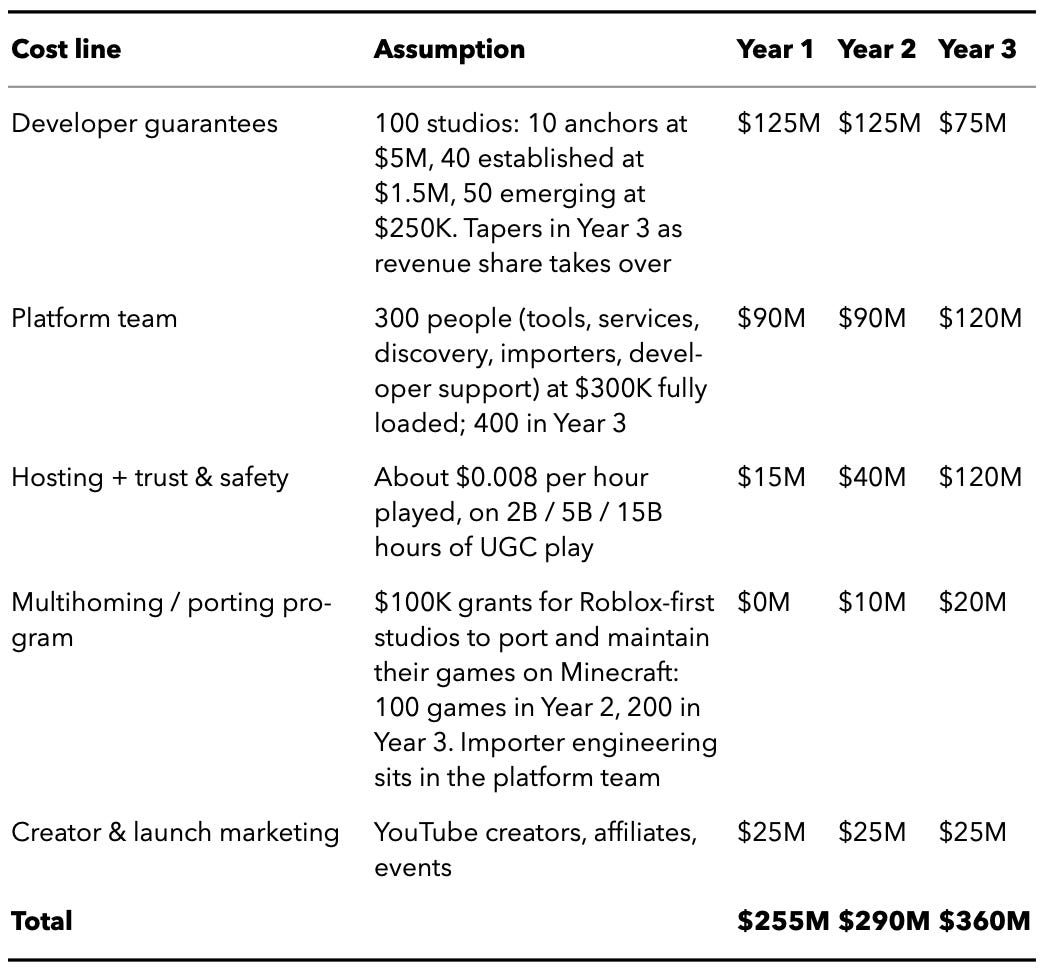
$905M over 3 years. This isn’t for the faint of heart. But let’s look at the potential outcomes:
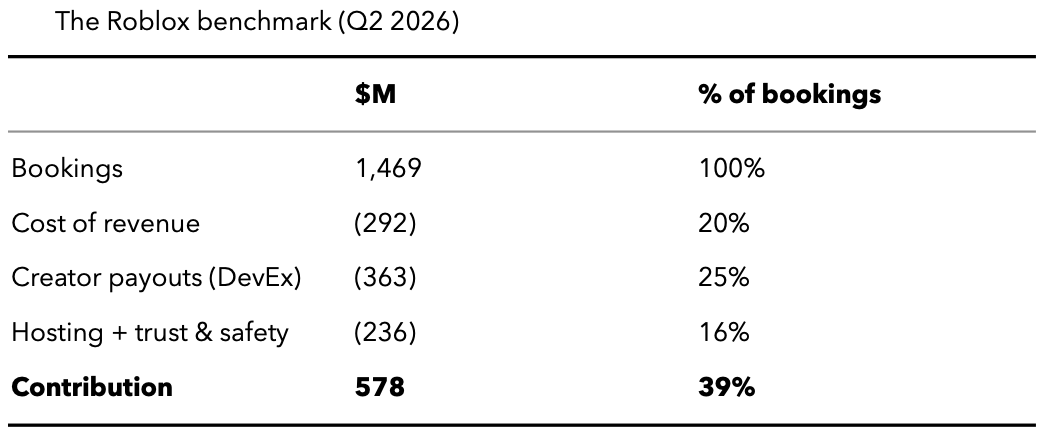
Roblox Q2 financials show a roughly 39% contribution margin on $1.46B. That’s well above CFO Amy Hood’s reportedly 30% accountability margin target set for the Xbox division. A division which has historically ran at 10-20%. Minecraft can be the margin-accretive growth engine for Xbox.
The outcome
Minecraft needs focus and discipline to execute this strategy. Notice I didn’t go over the details of monetization, game paradigms, and integration into the greater Xbox and Game Pass ecosystem? A lot of details are unknown and will be discovered through experimentation and testing on the journey from classic Minecraft in 2026 to dominant UGC platform Minecraft in 2030.
There isn’t a magical growth hack for Minecraft to go from where it is to where Roblox is. Everything required is very obvious, and that’s what makes these plans so difficult to execute. Few gaming properties possess a better starting position to build an industry-changing platform from, that’s what makes the opportunity worth pursuing aggressively.