


While working on my next indie game, I wanted to get in on the productivity hype by exploring and utilizing all the different “right ways to use AI”. I’ve tried everything from deploying armies of agents that decimate my feeble Claude and ChatGPT subscription token limits in minutes to micromanaging a single coding agent as if I’m a washed up athlete father desperately trying to get a second life of fame and fortune through their 9 year old’s youth league.
While exploring the world of what is being referred to as “the fourth industrial revolution”, I thought it would be interesting to share my current mental model for how and when to deploy modern AI tools in game development. To do so, I’m going to borrow from my favorite video format of the last few years.
There is a popular trend on YouTube over the last year of making “The 7 levels of” videos describing anything from pop singers to serial killers. Maybe my favorite example of this template is the amazing “The 7 Levels of Rappers” by YouTuber duplee.
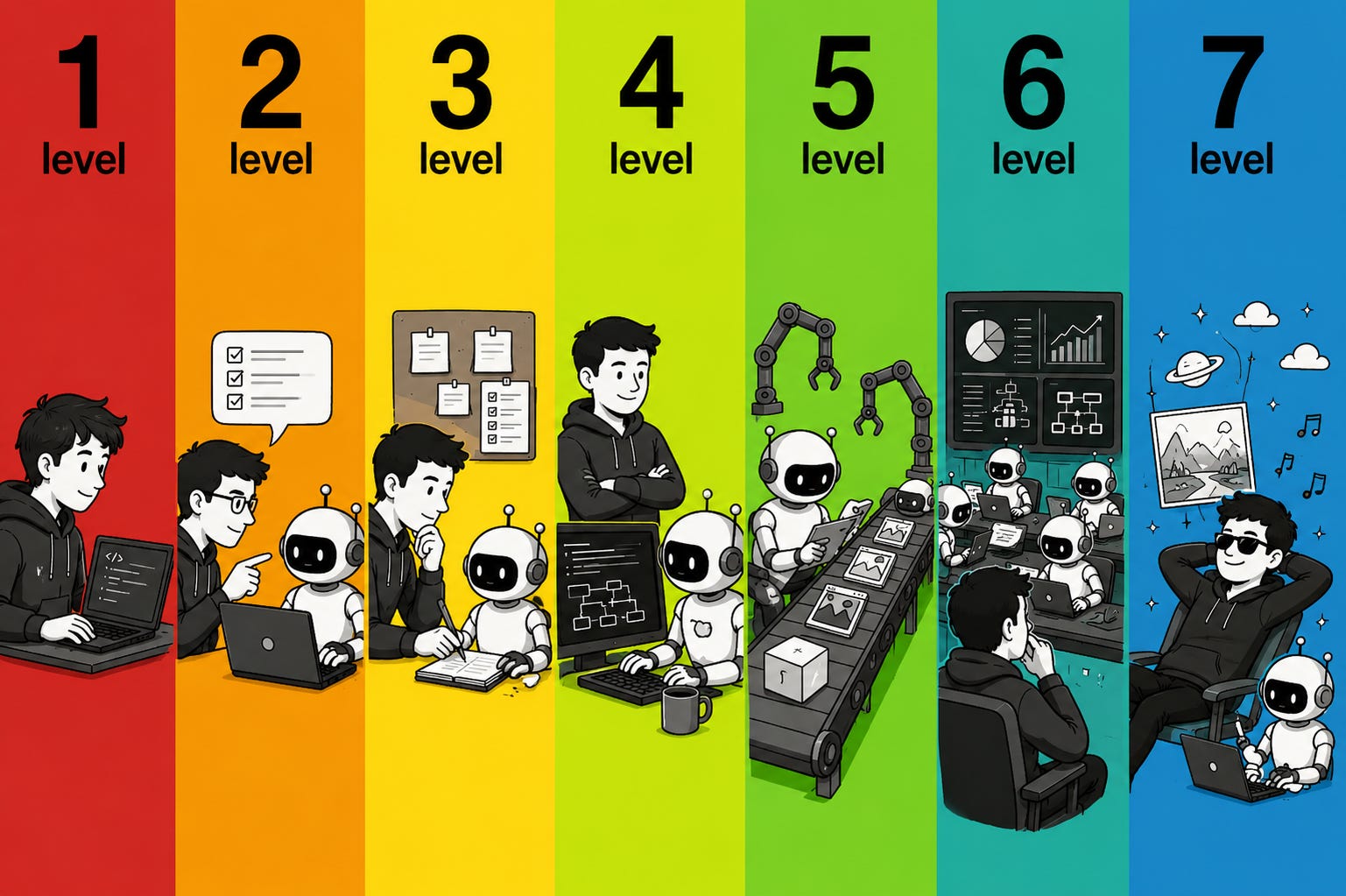
So without further ado, here are The 7 Levels of AI in Game Dev.
Level 1 - The Autocompletionist

You are barely dipping your toes into the AI hype cycle.
AI is merely an authoring tool like an expensive spellcheck, providing coding autocomplete or AI-based art tools. AI is not making decisions, generating game assets, or touching the repository. The Level 1 users might not even know they are using AI-based tools altogether.
You are making games in the traditional way and AI is nothing more than the latest built-in tool suite.
You aren’t spending noticeable amounts of tokens, likely the lowest tier subscription plans will suffice here.
Tasks so small they don’t seem AI-based: Autocomplete this line of code. Create boilerplate functions. Format classes to match a standard.
Level 2 - The Micromanager

You are using AI, but begrudgingly and in a stubborn manner. Nobody is going to accuse you of being an AI evangelist.
AI is doing the implementation work but not making any decisions. You determine what it does and how it does it. The AI is saving you time through keystrokes and asset fixes.
You are still making every decision in the game, using the AI as your input paradigm instead of keyboard and mouse.
You may be still in subscription-land or spending the equivalent of a Netflix subscription on tokens.
Smaller deterministic tasks: write a for loop, implement an array search, stuff that might appear on mid-level engineering interview tests.
Level 3 - AI Intern

Now you are handing off tasks to these trillion dollar products, but you are still not letting AI spread its little agentic wings.
AI is your overworked underpaid intern, minus the coffee runs and labor law violations. You give AI specific, smaller tasks to implement and check the work before it is committed to the repository. Like an intern, you aren’t letting the AI run off unsupervised. Also like an intern, you are not spending massive amounts of tokens so the work is coming cheap. Your main worry is AI confidently injecting garbage into your game.
You may not be making every single decision, such as low level implementation specifics, but your creative and technical vision is largely intact.
Small, bounded tasks: “make this UI button work,” “write a save/load helper,” “create a simple enemy state machine,” or “refactor this class.”
Level 4 - The System Builder

Here is where the productivity gains begin to show up. You have officially surpassed the chatbot phase and are fully into agentic workflows. You are allowing AI to make implementation decisions for systems with the aid of design documents and steering files.
You are still the architect, but AI is now the builder. AI is a beastly principal engineer, making implementation decisions and building systems autonomously at your direction. You define the architecture, constraints, and integration boundaries, your system builder will do the rest and commit to the repository. AI is building known systems, common features, while using time proven patterns
You are firmly in the land of paying for tokens but if you want to be AI first, this is worth it.
Medium sized, common game dev tasks: inventory, dialogue trees, save/load, hit detection, matchmaking UI.
Level 5 - The Feature Factory

You are no longer directing but instead handing off feature spec sheets and letting your star player take it from there. If you can become an AI-whisperer, your productivity gains are endless at this level.
You have moved beyond managing AI and into the world of product management PRDs. You are completely hands off in terms of implementation details, simply giving AI a list of requirements and leaving your dev partner to determine design patterns, optimizations, and any other sorcerer’s apprentice lack of details.
This is getting expensive now. Possibly still positive in terms of ROI on the token economy, but you can quickly find yourself with a $50,000 Codex bill after your AI decides to solve NP-complete problems overnight. Also, you need to be policing the repository or your new feature builder will turn it into its own hallucination playground.
Large feature level tasks: the entire combat system, world managers, matchmaking service, onboarding flows.
Level 6 - The Studio Simulator

You’ve hit the level the big VC players and Silicon Valley are salivating over, managing a giant fleet of agents to do your bidding. Congratulations, you’ve won AI.
At this level you are outsourcing a lot of your decision making and management to AI agents you’ve “hired”. Your army of agents roughly represents an entire studio with grunt agents building, design agents directing, and managerial agents overseeing and quality checking. If you master this workflow, you can produce high quality content in hours that would represent weeks of work in a traditional environment. What that content is though, is another question. You are very hands off at this point, to the point where the game is one hallucination away from the repository being nuked.
The agents are making so many decisions that you could question whether this work is copyrightable.
To perform these feats of modern computation you will pay like you’ve never paid before. As token costs continue to hockey stick to the heavens, so will your development costs. This will arguably cost more than hiring a team of developers so you’ll need to ask yourself if the speed is worth the price tag.
Entire game level tasks: build out a fighting game engine, create an Open World action adventure game, design and deploy a modding API for this existing game
Level 7 - Pure Vibe

Sit back, let go of the wheel, and allow AI to take you on a journey. You are describing the game or sections of the game loosely and letting the AI interpret it however it sees fit.
Can this even be considered game development? That’s for the philosophers to mull about. You are too busy vibing out the next tentpole franchise in gaming; that or you are asking AI to “make Hades but even cooler”. Don’t let the haters bring you down, this is your vision. Nobody else could have ever thought of “create the Witcher but as an anime”. Genius.
Costs? Who cares? What does it cost to not have your dreams come true? That’s the question you should be asking yourself.
Everything is generated: make a roguelike but with Pokemon characters, create Balatro using mahjong instead of poker.
What is the Correct Level?
Where you fall on the 7 levels describes where you are comfortable with automation in game development, which in turn depends heavily on what you are or are not using AI for. Level 7 might seem ridiculous to most unless you need a large quantity of placeholder or generic games to test an API or service. Level 1 might come off as a luddite unless you are doing very unique work such as optimizing a game for a chipset no LLM has trained on.
I’m not here to debate the ethics of which automations are correct or not in game development. As of writing this the TL;DR from a non-lawyer is:
Human authorship is a requirement for copyright
Prompts are not human authorship
Training on copyrighted material is still under litigation; AI developers claim fair use citing that using works to train LLMs is transformative
You are still held liable if you use AI generated assets that infringe on copyright
After you sort your own ethics out, you need to also take into account the current zeitgeist of players around generative AI usage. 115% of all Steam capsule images are accused of being AI slop. Anytime game text includes an ‘-’, it is AI slop. And if you fail the purity test’s ever moving goalpost, prepare to be review bombed, by AI bots, into the SEO wasteland.
I currently bounce between Level 2 and Level 3. I find the games I make to be familiar enough for AI to help with small implementations, but unique enough that if I let Claude Code or OpenAI Codex create systems I always regret it no matter how detailed the steering files are. If anything, AI is my end of the night keyboard replacement, so I can watch TV, drink scotch, and haphazardly fix logical errors in my game.
Where do you stand on the new frontier of development?