


What is studio innovation? Is FromSoftware more innovative than Square Enix? Is EA innovative, or is it creatively bankrupt? The answer is they’re all innovative, but they’re executing innovation over different portfolio playbooks. Some studios grind on the same IP for decades. Some launch a new franchise every release. Some take an old franchise into a genre it’s never touched. And some mint a new IP in a genre it’s never touched, every single time. After cataloging 229 major releases across sixteen publishers, a clear pattern fell out: every studio has its own innovation profile.
Since diving into the great Xbox reset, I’ve been thinking about what the best IP playbooks are. I created the Innovation Profile Map as a framework to describe where game companies are in their IP strategy. However IP strategy isn’t a static plan. In a growth stage companies might launch a new franchise every release, in a maturity phase they may reinvent existing franchises, and if a company is really feeling themselves, they might take major swings venturing into uncharted territories.
On one axis we have IP Leverage vs IP Creation. What percent of releases does the company launch a new IP?
On the other axis we have Incremental Strategy vs Transformational Strategy. What percentage of existing franchises entered a genre or business model they had never occupied before?
The Profile Guidelines
Timeline: only counting releases in the last 10 years.
Scope: major/notable new releases only. Remasters, remakes, ports, DLC/expansions, and minor spinoffs are excluded. Annual sports sequels (FIFA/EA Sports FC, Madden, NBA 2K, etc.) are excluded.
“New IP”: the title is not a sequel or spinoff of an existing franchise from that studio.
“New paradigm”: the FIRST time that specific IP appeared in a given genre OR a given business model/format (premium single-player, F2P live-service, mobile gacha, subscription, etc.), yes if either is a first for that IP. By definition, every new IP automatically counts as a new paradigm.
Conglomerates: Rockstar and Take-Two are kept separate (Take-Two = 2K/Firaxis/Gearbox/Private Division only). Riot and Supercell are kept separate from Tencent (Tencent = TiMi/LightSpeed/Grinding Gear Games/Funcom only). Bandai Namco is internal studios only, FromSoftware-developed titles (e.g. Elden Ring) are excluded and counted under FromSoftware.
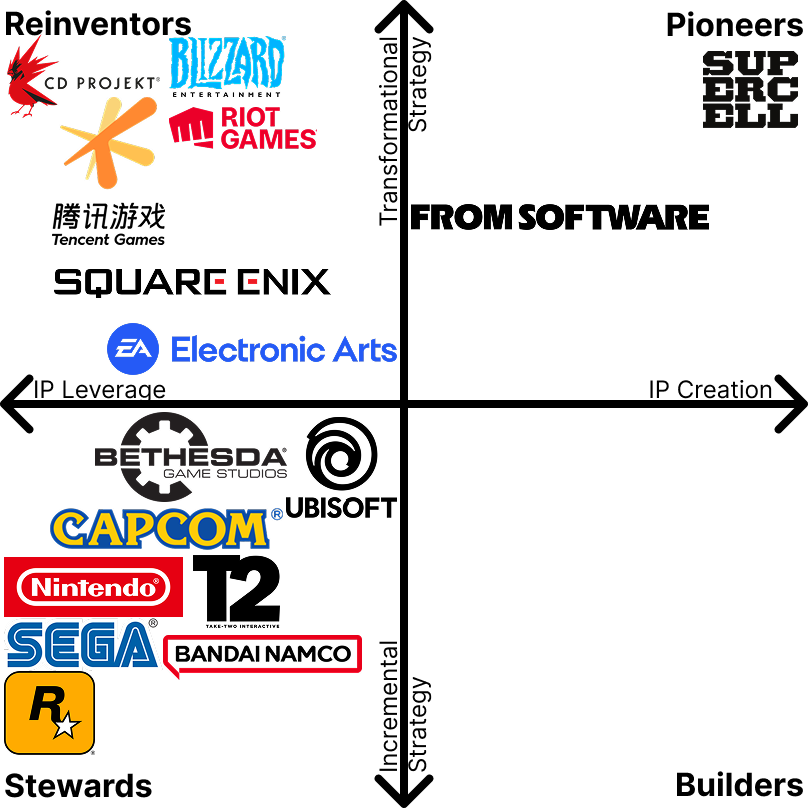
We see some major trends that reveal the basic business strategies of video game portfolio management.
How do you survive 40 years in the game industry? The most recognizable game companies are in their mature phase, mostly leveraging their existing IP but still taking calculated risks to keep their portfolio fresh. These companies own gaming’s closest equivalent to blue-chip assets. These are some of the most familiar faces: Nintendo, Sega, Bandai Namco, Take-Two, Rockstar, and Capcom, a who’s who of greatest game companies of all. Want to last two, three, or four decades in the game industry? This is the strategy.
How do you turn your studio into a consistent asset? Explore for your next tentpole franchise using your existing money printer. Bethesda has Fallout and Elder Scrolls, Ubisoft has Assassin’s Creed and Far Cry, and EA (remember we’re not counting sports franchises) has Sims 4 expansions and Battlefield. I’ll also lump Square Enix who might have the deepest roster of IP but is mainly known for Final Fantasy and Dragon Quest reliably moving units. This group doesn’t take massive innovative swings but tests new paradigm waters with their back catalog and takes chances on new franchises on a regular basis.
How do you keep IP fresh and alive? Use your IP in new and in-vogue ways. The poster child of this is Blizzard who wouldn’t surprise anyone if they were launching Warcraft cart racers. Then we have Riot Games, who has put League characters in fighting games and auto chess. Also we have CD Projekt Red, who has multiple Witcher entries, and Tencent, whose releases look like a hodgepodge of other people’s property counting as theirs. Each of these companies is maximizing the return on a successful universe by repeatedly expanding it into new categories.
What does it look like to take charge of the entire game industry? Finally we have the perennial AAA darling FromSoftware and our lone mobile entry Supercell. FromSoftware occupies an unusual position. It consistently creates new worlds while simultaneously expanding its design capabilities. Sekiro and Elden Ring stretched the studio’s proven formula into stealth, open worlds and large-scale exploration. Supercell is a reflection of mobile development at its best. Sure it’s difficult to compare Brawlstars to Elden Ring, but Supercell is constantly testing new paradigms under new franchises to great success.
So where is the bottom right? This quadrant would include mobile studios, specifically in categories such as social casino, match-3, and war strategy. Instead of reinventing gameplay, these studios repeatedly ship proven systems within the same genre, using the same live ops playbook, but with different thematic wrappers to reach different audiences. The innovation is portfolio maximization. Sciplay and Peak Games come to mind.
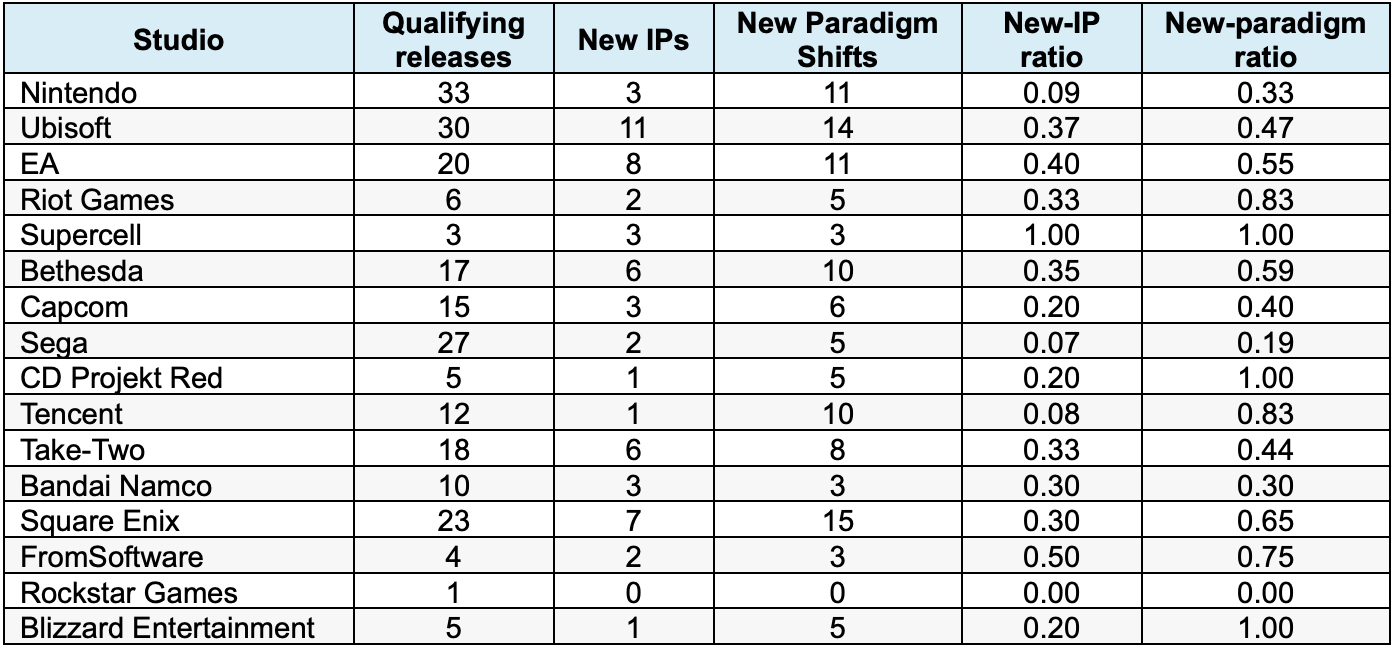
Our game companies by the numbers
Limitations:
Ten-year window
Sample-size differences
New IP mechanically counts as a new paradigm
The next time a studio announces something, don’t jump to hot takes on whether it’s a creative or a cynical move. Ask which playbook they’re running, and what phase they’re in. A studio leveraging their golden IP in a high-LTV paradigm is farming margins. A studio minting new IP is buying a bigger audience. Both are inherently innovative moves; it depends on what they’ve got and what they need. Nintendo is compounding trust, Ubisoft is searching for their replacement franchise, and Riot is monetizing one universe across multiple games.
Because after looking across sixteen publishers, one thing is clear: the biggest companies don’t innovate game by game. They innovate across a portfolio over time.
Appendix
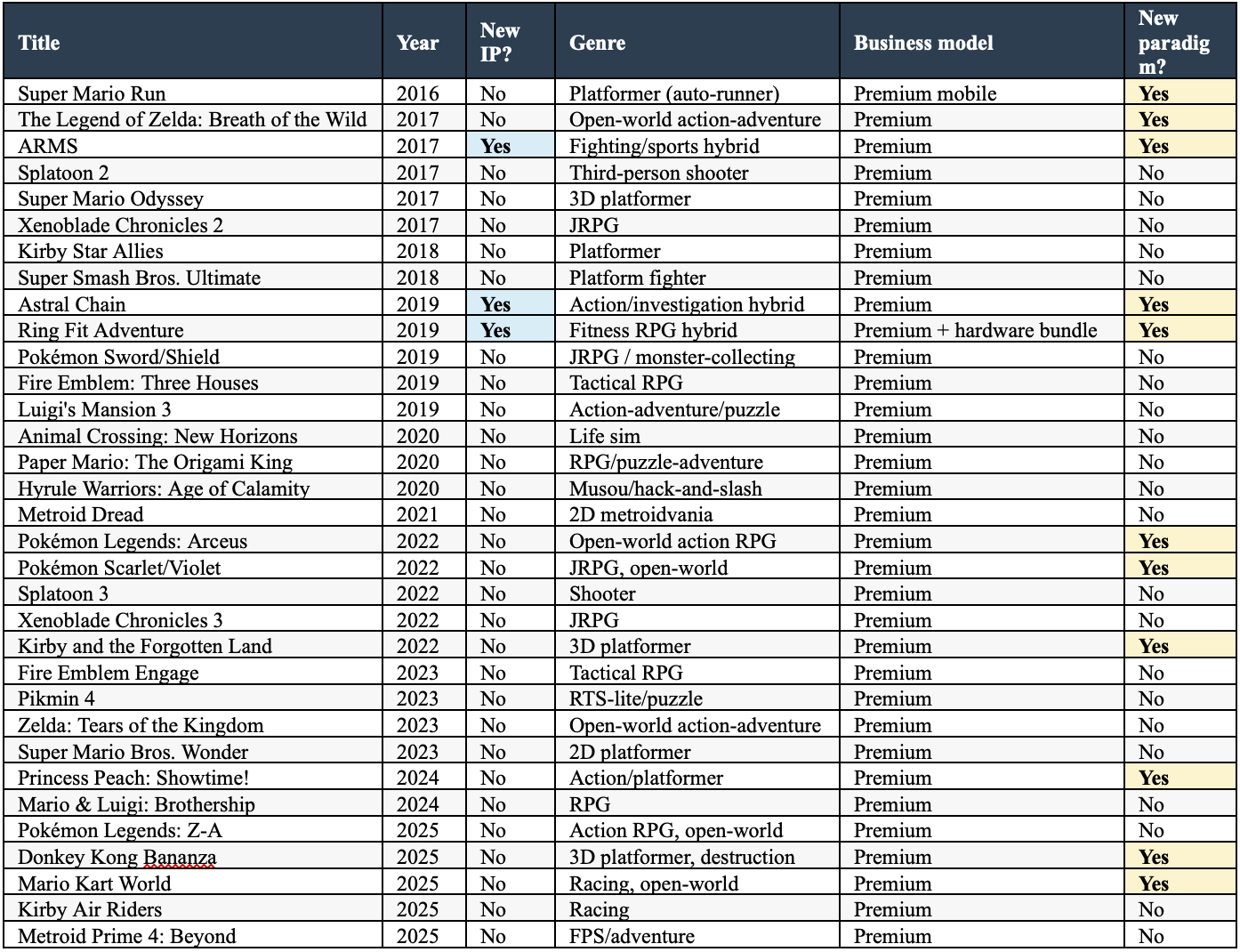
Nintendo
33 qualifying releases · 3 new IPs · 11 new-paradigm titles · new-IP ratio 0.09 · new-paradigm ratio 0.33
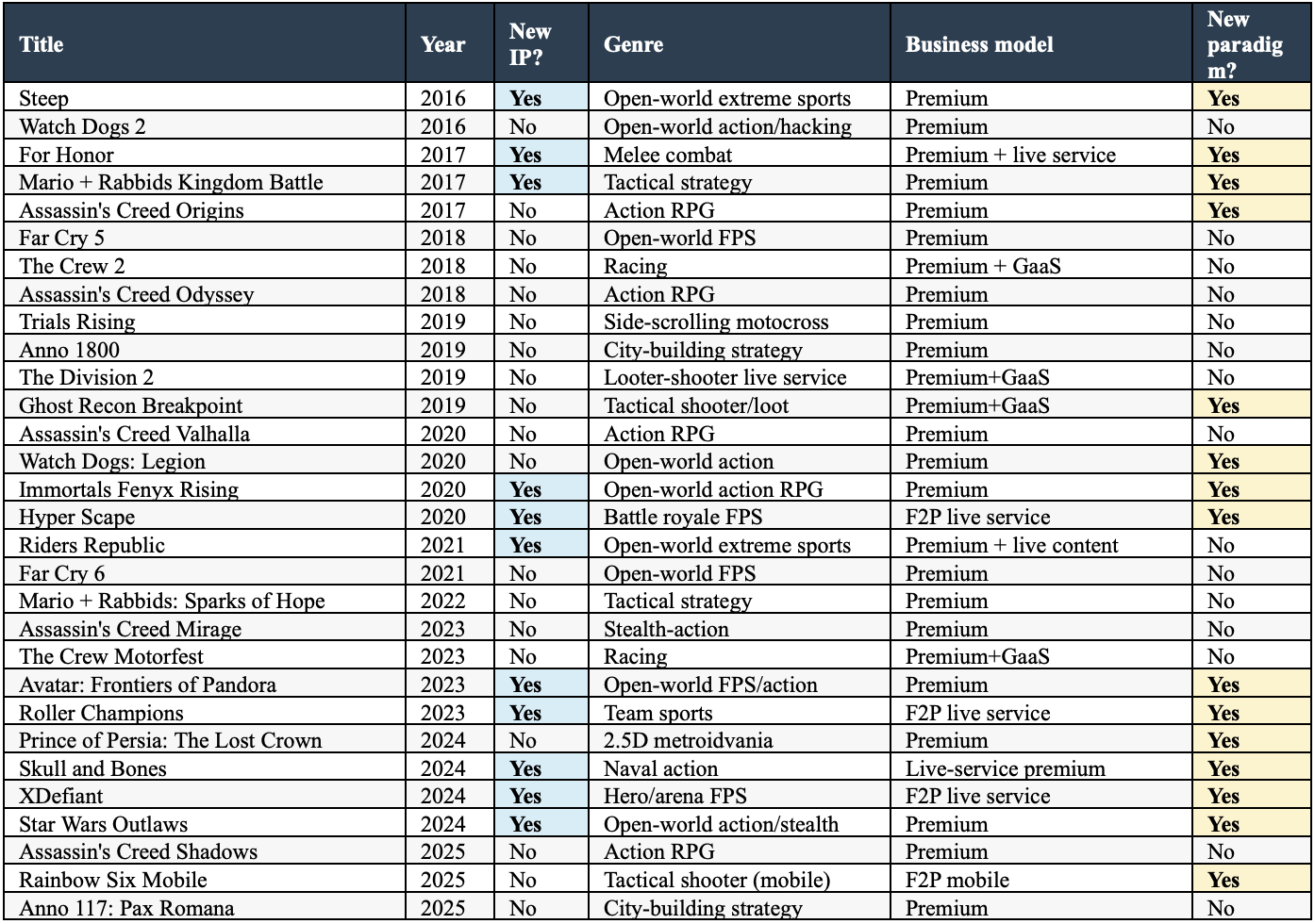
Ubisoft
30 qualifying releases · 11 new IPs · 14 new-paradigm titles · new-IP ratio 0.37 · new-paradigm ratio 0.47
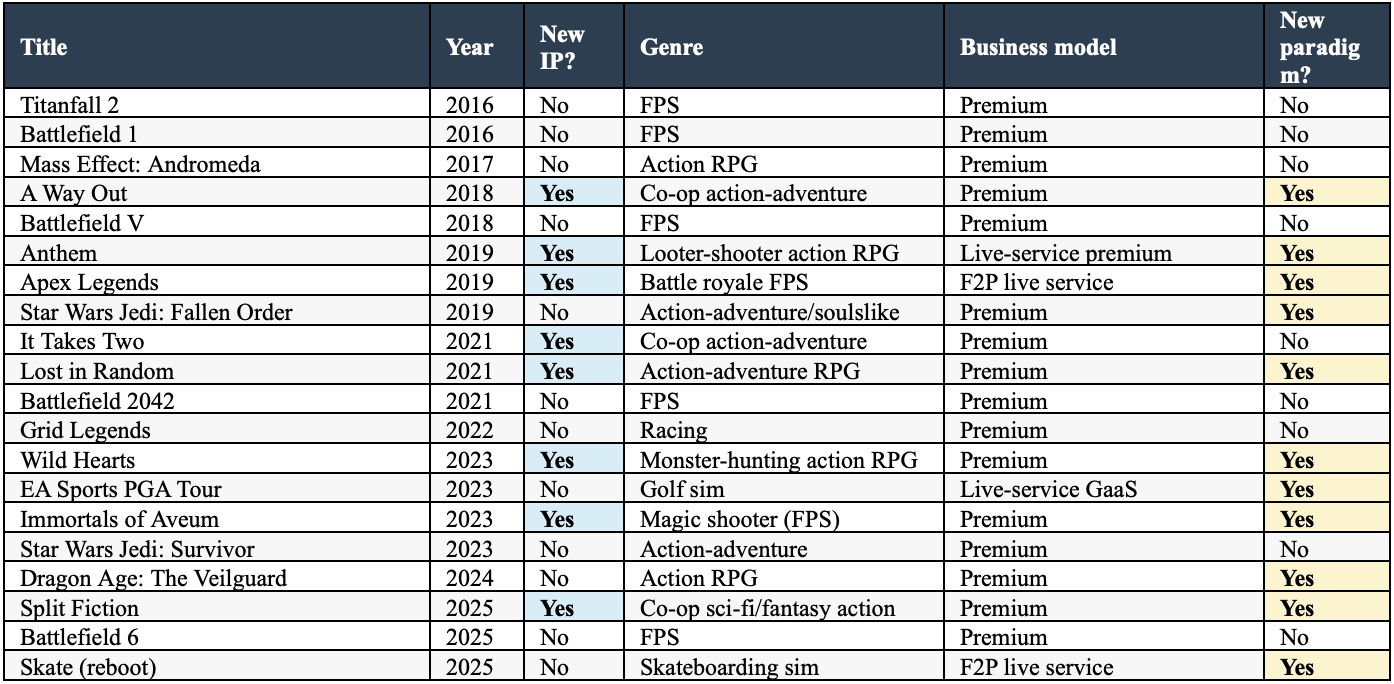
EA (incl. EA Sports, DICE, BioWare, Respawn, Maxis, Codemasters, EA Originals)
20 qualifying releases · 8 new IPs · 11 new-paradigm titles · new-IP ratio 0.40 · new-paradigm ratio 0.55
Riot Games
6 qualifying releases · 2 new IPs · 5 new-paradigm titles · new-IP ratio 0.33 · new-paradigm ratio 0.83

Supercell
3 qualifying releases · 3 new IPs · 3 new-paradigm titles · new-IP ratio 1.00 · new-paradigm ratio 1.00

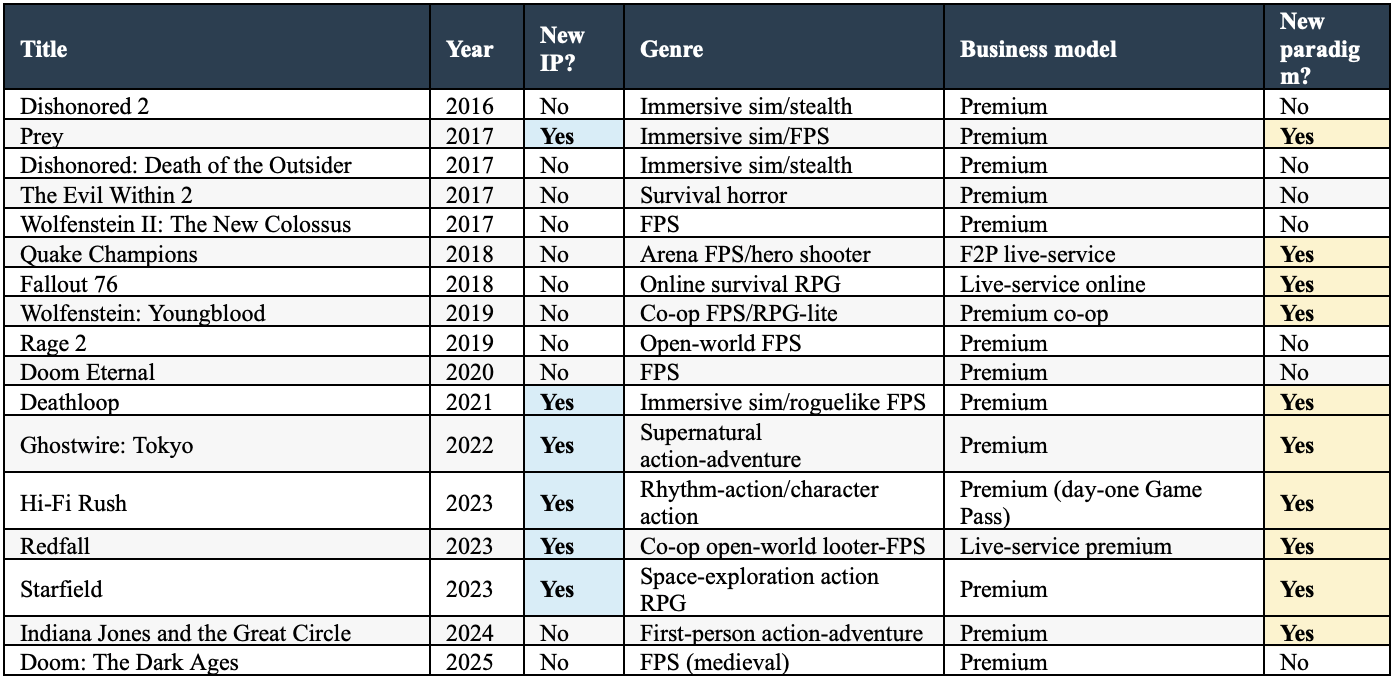
Bethesda (incl. id Software, Arkane, MachineGames, Tango Gameworks)
17 qualifying releases · 6 new IPs · 10 new-paradigm titles · new-IP ratio 0.35 · new-paradigm ratio 0.59
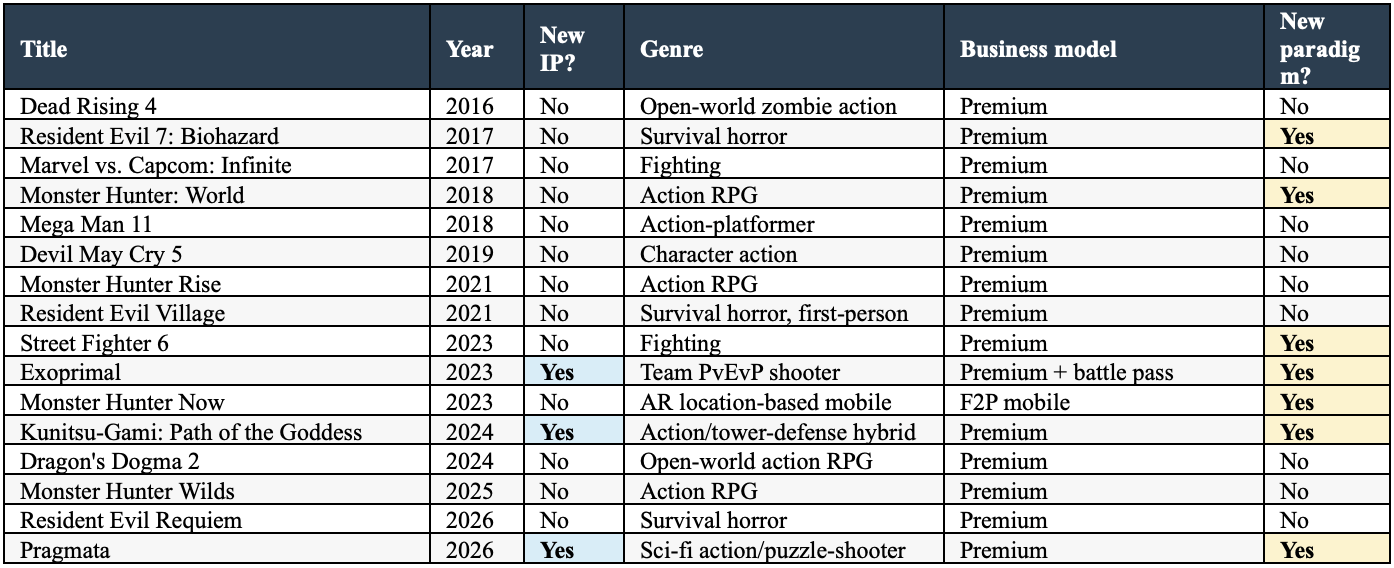
Capcom
15 qualifying releases · 3 new IPs · 6 new-paradigm titles · new-IP ratio 0.20 · new-paradigm ratio 0.40
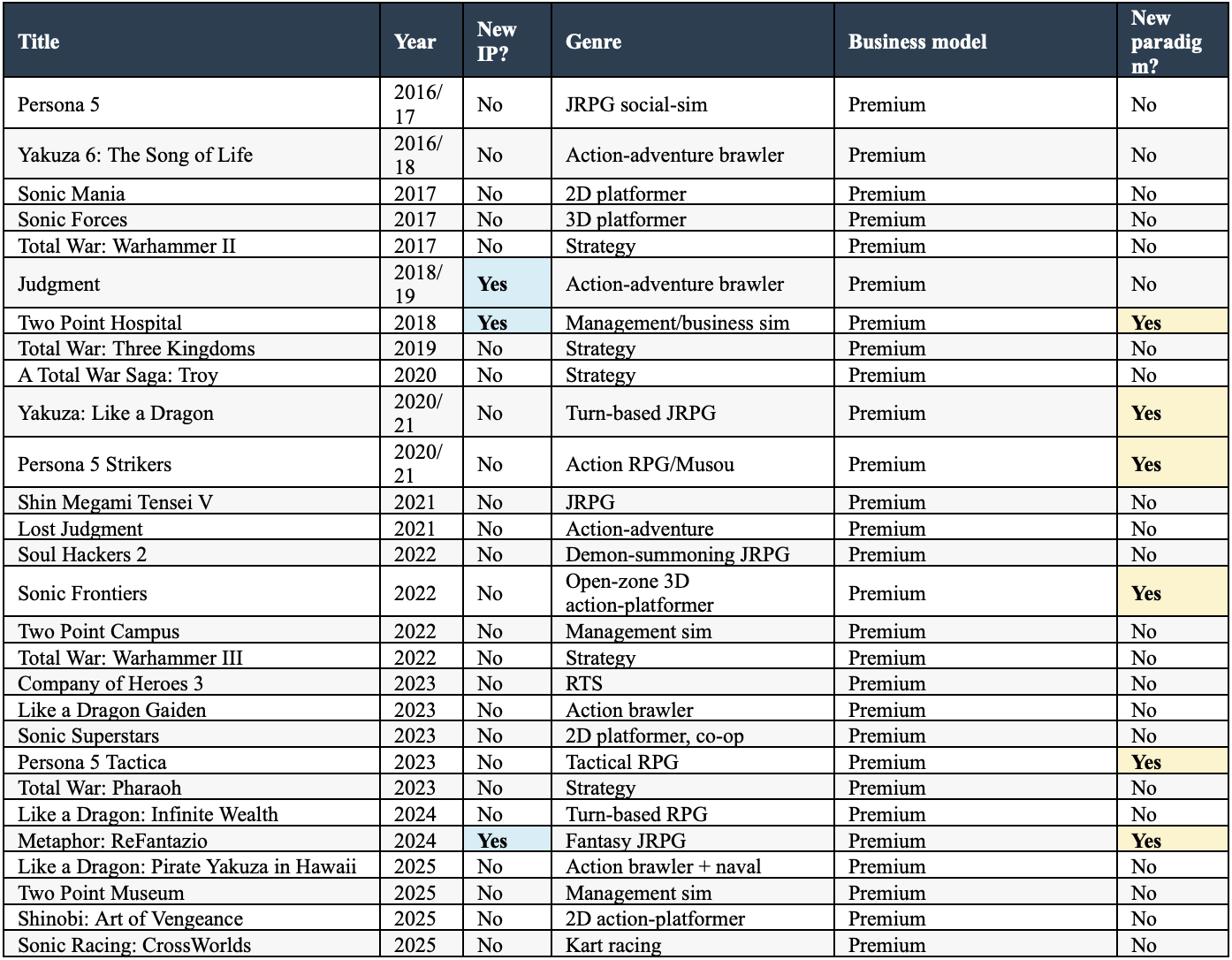
Sega (incl. Atlus, RGG Studio, Sonic Team)
27 qualifying releases · 2 new IPs · 5 new-paradigm titles · new-IP ratio 0.07 · new-paradigm ratio 0.19
CD Projekt Red
5 qualifying releases · 1 new IP · 5 new-paradigm titles · new-IP ratio 0.20 · new-paradigm ratio 1.00

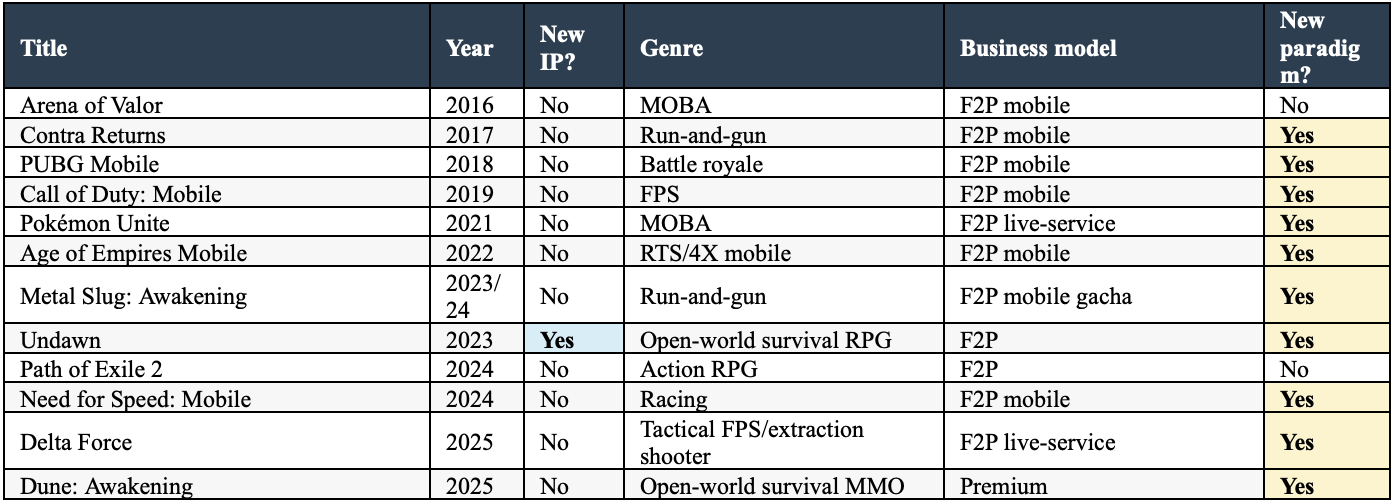
Tencent (TiMi, LightSpeed, Grinding Gear Games, Funcom — Riot/Supercell excluded)
12 qualifying releases · 1 new IPs · 10 new-paradigm titles · new-IP ratio 0.08 · new-paradigm ratio 0.83
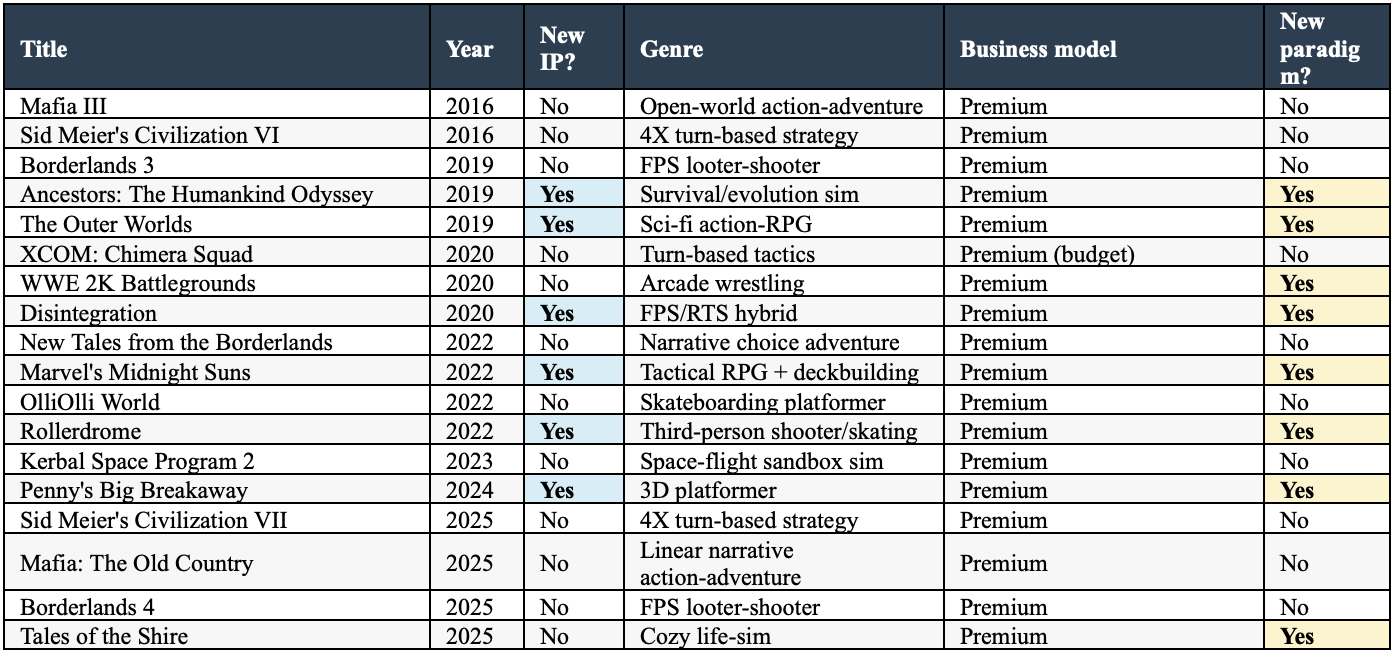
Take-Two (2K, Firaxis, Gearbox, Private Division — Rockstar excluded)
18 qualifying releases · 6 new IPs · 8 new-paradigm titles · new-IP ratio 0.33 · new-paradigm ratio 0.44
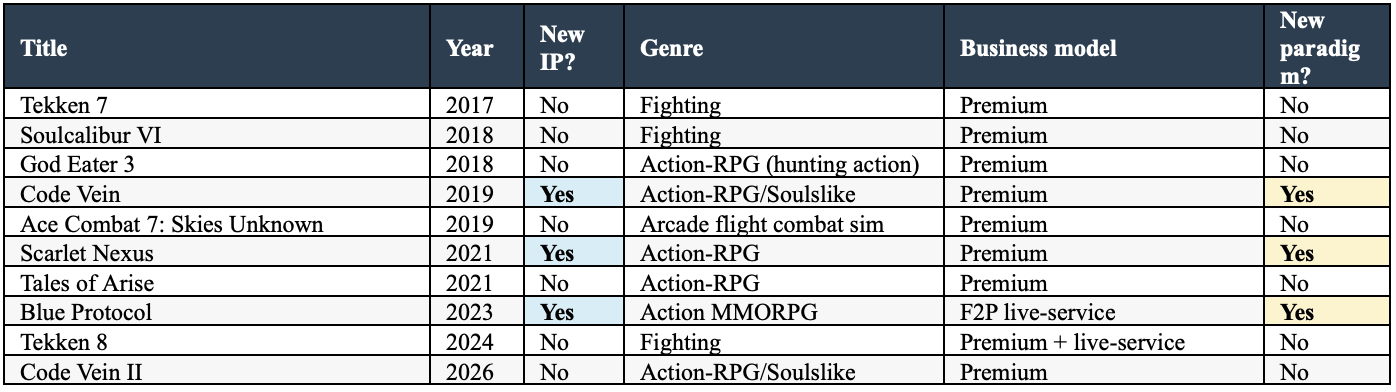
Bandai Namco (internal studios only)
10 qualifying releases · 3 new IPs · 3 new-paradigm titles · new-IP ratio 0.30 · new-paradigm ratio 0.30
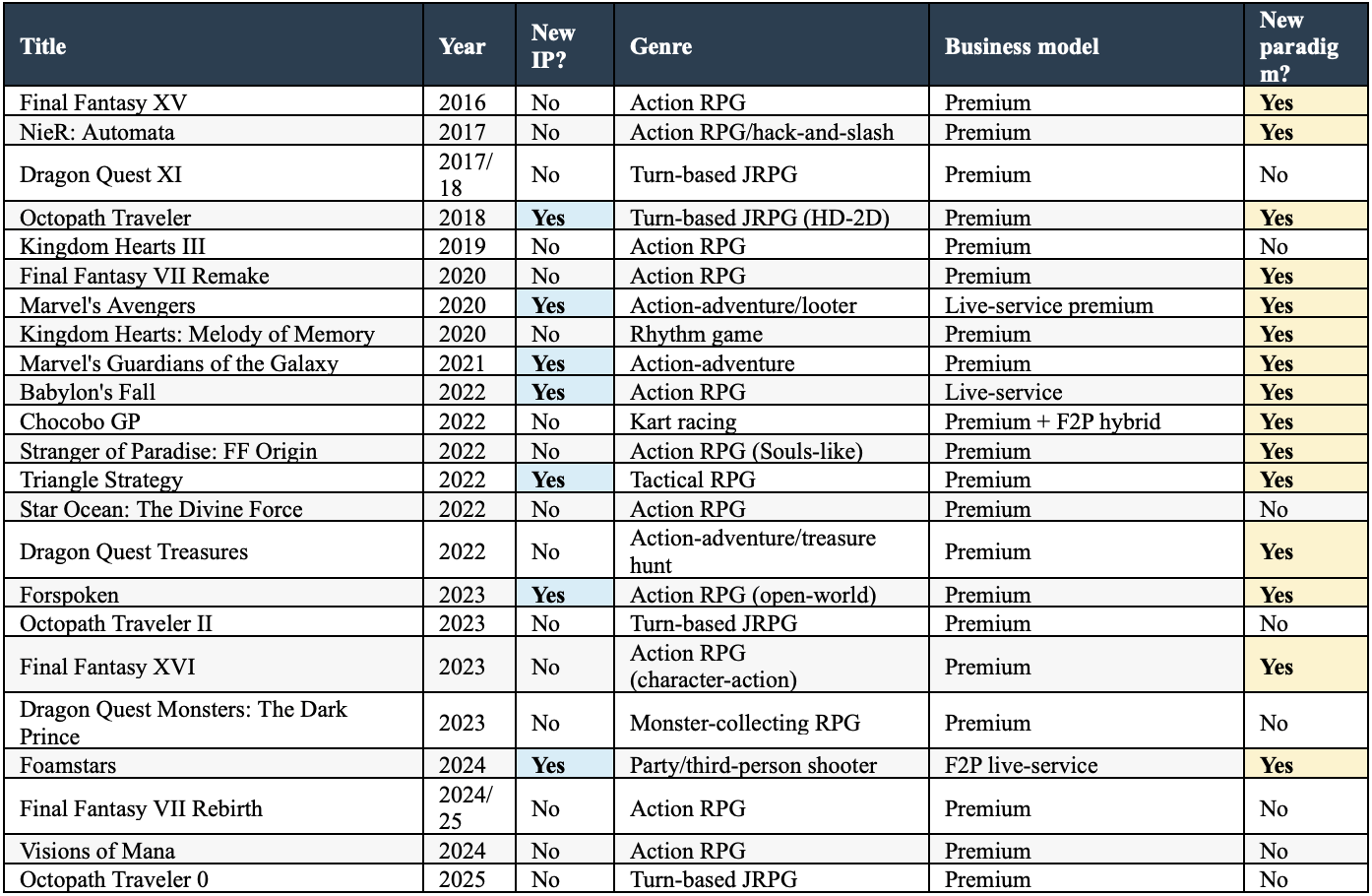
Square Enix (incl. Crystal Dynamics/Eidos Montreal pre-2022 sale)
23 qualifying releases · 7 new IPs · 15 new-paradigm titles · new-IP ratio 0.30 · new-paradigm ratio 0.65
FromSoftware
4 qualifying releases · 2 new IPs · 3 new-paradigm titles · new-IP ratio 0.50 · new-paradigm ratio 0.75

Rockstar Games
1 qualifying release · 0 new IPs · 0 new-paradigm titles · new-IP ratio 0.00 · new-paradigm ratio 0.00

Blizzard Entertainment
5 qualifying releases · 1 new IPs · 5 new-paradigm titles · new-IP ratio 0.20 · new-paradigm ratio 1.00
