


I know, another barn burner of a title. Business strategy books are determined to reinforce the moats of unapproachable titles. Playing to Win is a strategy framework to guide companies from aspirational success to the systems and processes that deliver outcomes. Surely we’re all playing to win in video games? After all, this is one of if not the most competitive entertainment space to be in; with the rewards for success being higher than music and film combined. Well I’m here to say no you aren’t.
The video game industry is hitting a growth ceiling and it is more difficult than ever to launch and sustain a new IP. At the same time, the games industry often confuses strategy with taste, vision, or feature ambition. Playing to Win is the book we need now more than ever. Go from “people will love my vision” to “my game can actually survive in the market.” So buckle up, put on your learning cap, and get ready to finally play to win.
Playing to Win: How Strategy Really Works
Playing to Win was written by A.G. Lafley, former CEO of Procter & Gamble, and Roger Martin, former dean of University of Toronto’s Rotman School of Business. Yes, the guy who led Tide and Pampers is going to teach you more about succeeding in video games than any GDC talk or game dev influencer.
The crux of the book is that businesses succeed or not based on their strategy and how well each employee understands and executes that strategy. If a game doesn’t have a compelling direction and position in the market, it can’t succeed. Furthermore, even if a game does have an amazing direction and well thought out business strategy, it doesn’t mean anything if the developers that bring the game to life don’t understand and execute that strategy.
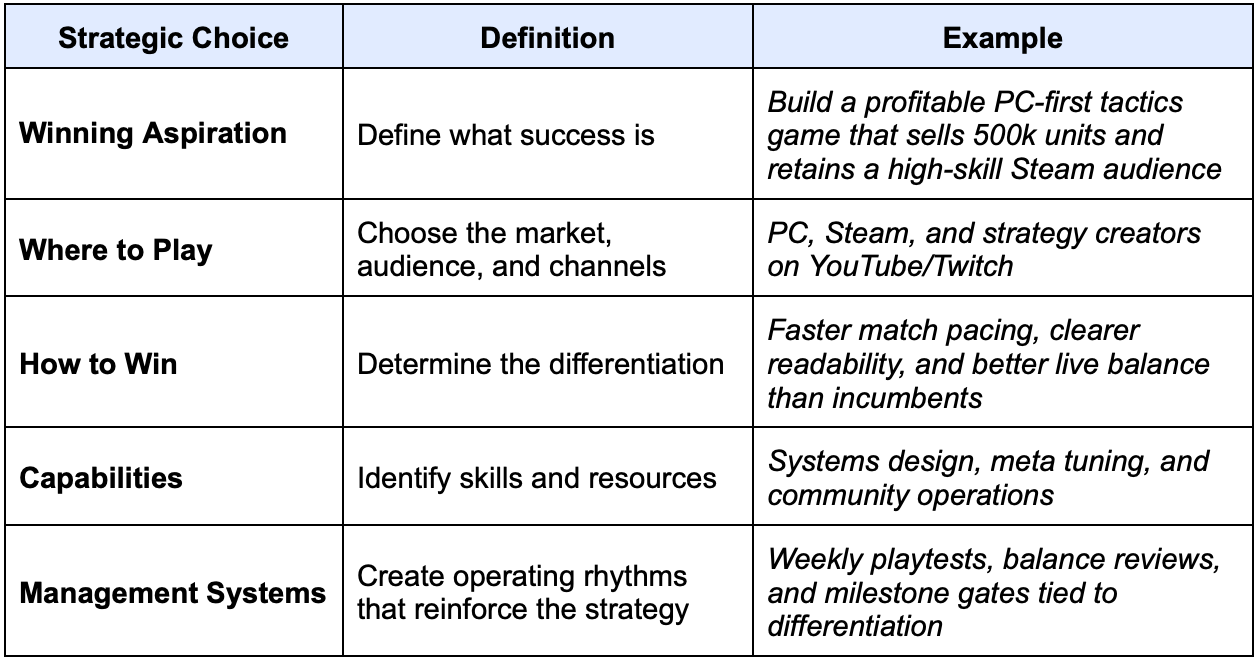
To have a sound business strategy, Lafley and Martin identify 5 strategic choices that must be satisfied in order:
What is our winning aspiration?
Define the company’s success state. Generally a measurable outcome such as revenue or position in a market.
Fortnite’s aim to become a “metaverse” platform that merges gaming, social, and user-generated content (UGC).Where will we play?
Determine the specific markets, customers, channels, and product categories.
Roblox’s where to play is a platform model built around user-generated experiences.How will we win?
Determines the unique way the company will compete and succeed in its chosen playing field. Differentiation and pricing power are examples of a winning thesis.
One of Valorant’s differentiators is its investment in anti-cheat, Vanguard.What capabilities must we have in place to win?
Identifies the specific skills and resources needed to execute “how to win”.
Supercell’s independent “cells,” team autonomy.What management systems are required to support our choices?
Establishes the processes and systems to ensure the other four choices are consistently made and supported.
Supercell’s willingness to shut down projects that do not meet its bar.
“But my game studio is going to win the Hero Shooter market by releasing a 4 out of 10 iteration of Valorant/Overwatch/Deadlock/etc.”
Exactly. Most game studios truly struggle to define these 5 steps. Or they can define them, but they aren’t accurate or realistic. Lafley and Martin provide a framework to outline how a company achieves its goals and gains a competitive advantage in a marketplace.
Who should read this?
Like with 7 Powers, you are not going to suddenly level up as a developer and become the next indie darling or auteur AAA director by reading Playing to Win. To be honest, most of the book uses CPG products like mops or diapers as case studies. Instead, this book is going to give you tools to identify and focus on the meaningful actions to achieve whatever you define as success: gross revenue, award nominations, job offers, or the ever-elusive “artistic expression”.
Startup Founders
Want to laser focus your pitches and execution on what actually matters vs optimizing vanity performance? You will learn how to bridge the hockey-stick winning aspiration you are selling with the sober operational plan that investors want to see acknowledged.
Indie Devs
Buy this book so you are no longer entering crowded markets like roguelike or platformer armed with nothing but “good gameplay” and a prayer. Figure out who you are making games for, which differentiators they actually care about, and what you need to be better at than the dozens of other indies shipping into the same market.
AAA Dev
AAA teams rarely fail because they cannot execute, they fail because they execute at massive scale against fuzzy strategy. Playing to Win helps teams communicate and embed a real “how to win” thesis into culture, process, and decision-making. The goal is not just to build a polished looter shooter. It is to build one with a clear path to winning its audience in a brutally competitive market.
Publisher
Go from sorting through pitches and hoping one hits to having a framework for identifying strategic quality early. Learn how to craft a strategy based on a budget and industry landscape, helping identify which games have the ability to execute a winning thesis.
Position every project with a winning thesis and a focused marketing plan. Determine what is required to deliver the winning thesis and how to structure milestones to support how to win.
Gaming Executive
This is the most useful audience for the book. Studio initiatives, team structures, portfolio reviews, and operating rhythms should all reinforce the same strategic choices. Playing to Win gives executives a way to align organizational design and decision-making around a coherent path to winning instead of letting every function optimize for its own local goals.
Investor
Learn to develop an investing thesis that links the technology, genre, or business model you are investing in with the studio capabilities and management systems of the startups you are considering. Connect your individual investments to the fund’s investment thesis.
Should I buy this?
For the price of the next disappointing Oscar-bait you regretfully bought a ticket to, you can learn how to change the trajectory of your next big game. The game industry has been playing to stay employed, it’s time for us to start playing to win. Your games are lacking a framework to connect your outcomes to the structures and processes that deliver them. This is the unsexy stuff that works on every product from toilet paper to fighting games. This is not a creativity book. It is a survival manual for making games that can actually break through.