


Once one of the big 4 of North American publishers alongside Take Two, EA, and Activision, Ubisoft has gone on a legendary fall from grace that features hostile takeovers, privatising founders, and foreign white knight investors. I covered a brief history of Ubisoft’s troubles leading to the 2024 Tencent investment:

but Ubisoft’s woes warrant a deeper look.
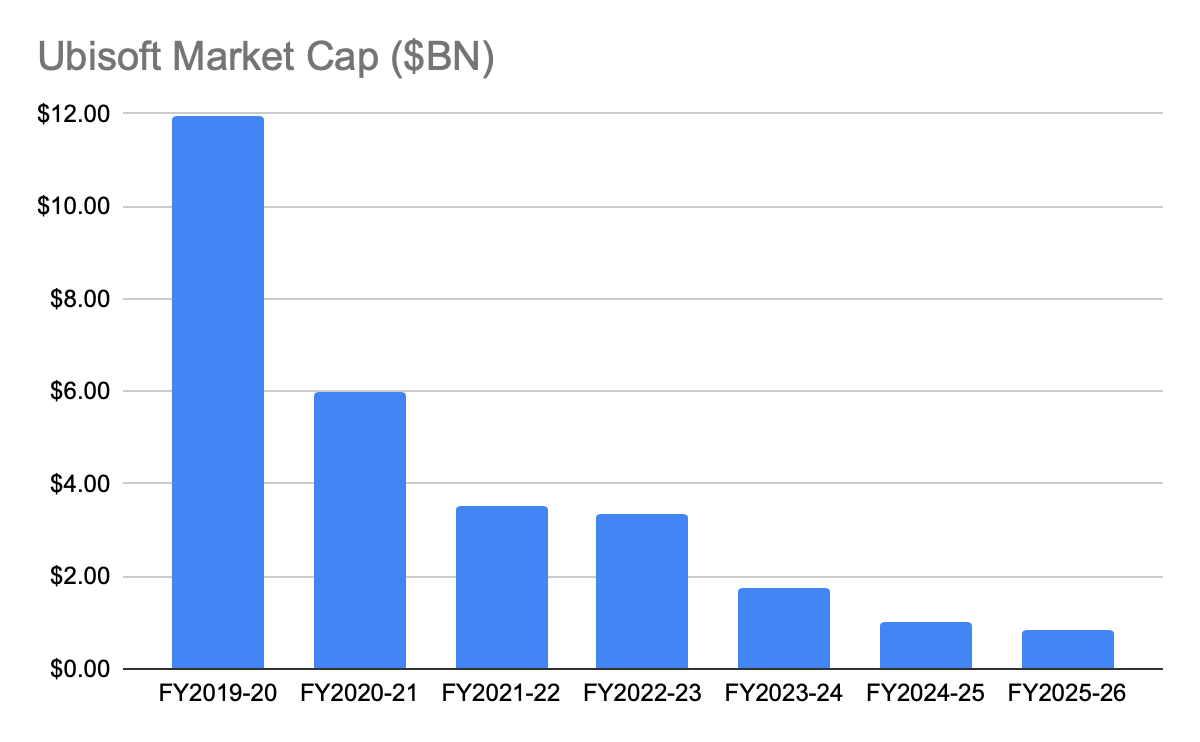
Ubisoft Market Capitalization in USD Billions (2020-2026)
What led Ubisoft to $11BN (USD) in market cap destruction over a 6 year period? I’m looking for answers more than “their games aren’t as good” or “they need to release more games.” Last time I looked into the investment and shareholder history of Ubisoft, this time I want to take a look at the public market reports and figure out what’s going on with Ubisoft.
Free Cash Flow
Free Cash Flow is considered the king of financial reporting. It represents the actual cash a company generates after funding its operations (payroll and daily expenses) and capital expenditures (funding new games).
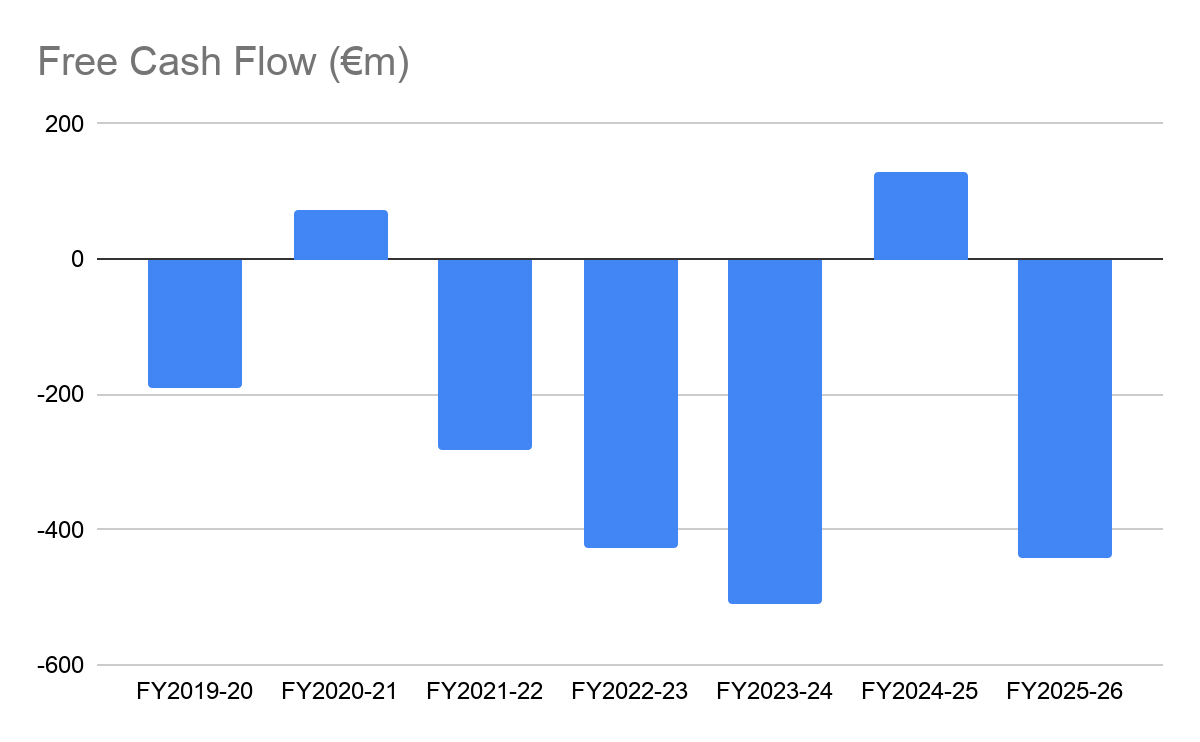
Ubisoft Free Cash Flow in Euro Millions (2020-2026)
It’s very clear Ubisoft has either a spend problem, revenue generation problem, or both. It’s unlikely Ubisoft is making massive investment for 2026 that are still awaiting to pay off. The outlier years, FY2020-21 and FY2024-25, both saw major Assassin’s Creed releases, Valhalla and Shadows respectively.
Net Bookings
The top of the funnel revenue generation for a game publisher. This measures the total value of products (premium game sales physically or digitally) and services (IAPs or subscriptions).
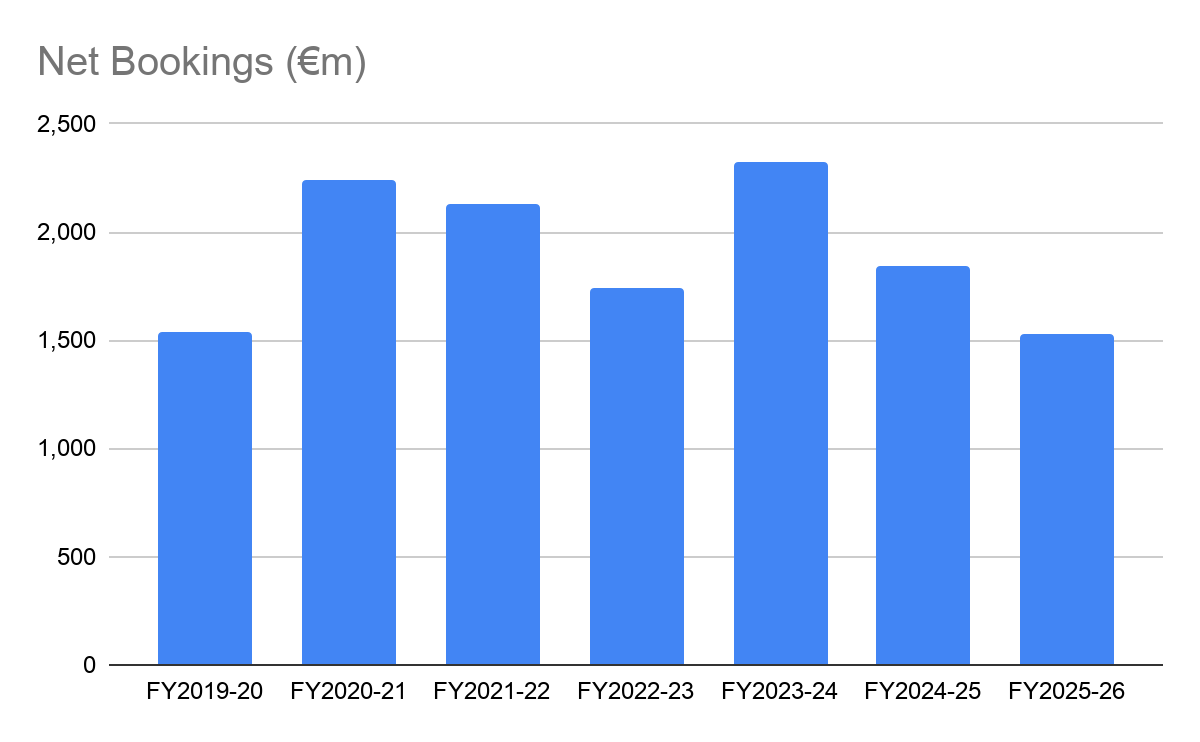
Ubisoft Net Bookings in Euro Millions (2020-2026)
It looks pretty volatile across the years in market cap decline. Video game publishers and studios are hit driven business, so although they try to offset years where tentpole IP launches occur with DLC, live ops, and supporting franchises, you will still see peaks and valleys in revenue year-to-year.
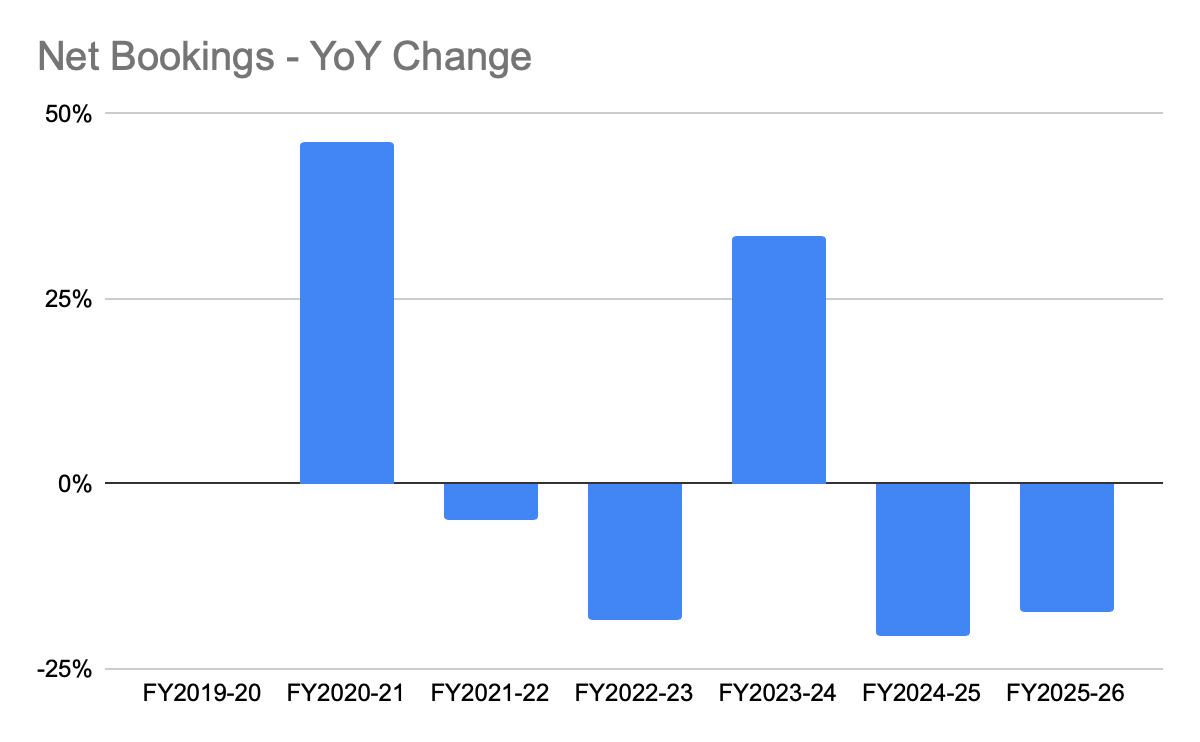
Ubisoft Net Bookings Year-over-Year change (2020-2026)
But alas, topline revenue is too dependent on hits.
R&D Intensity
R&D might spark images of scientist in lab coats mixing brightly colored liquids between beakers, but in the game development world in means:
Internal Game Development Salaries, benefits, and payroll taxes for developers
External Development and Co-Development Outsourced development and partner studio work
Internal Technology Development Game engines, tools, and production technology
Live-Service Development New game content, systems, features, events, and technical support
Impairments and Write-Downs Cancelled, delayed, or underperforming games relative to their forecasted performance
R&D is pretty much anything that isn’t marketing, distribution, administration, customer service, and IT.
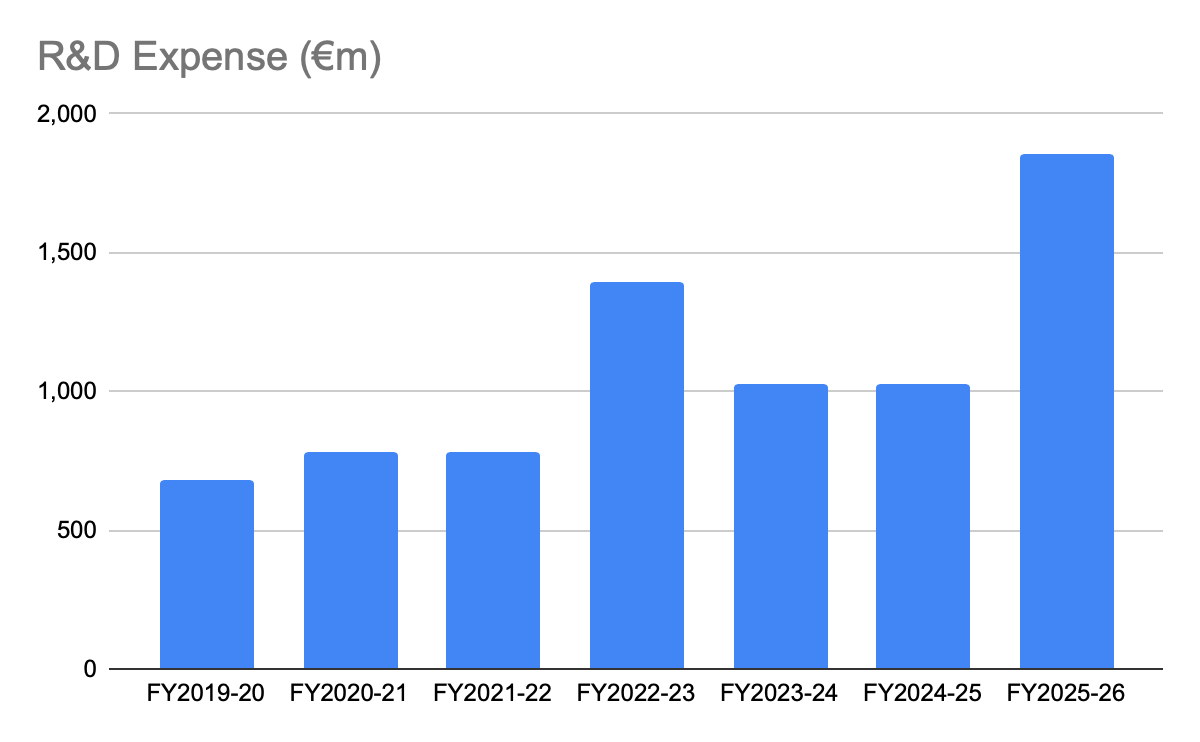
Ubisoft Non-IFRS R&D Expense in Euro Millions (2020-2026)
The last category is particularly pertinent as giant swings in R&D costs are the result of games not delivering against forecasts. And as we’ll see, R&D costs are a key protagonist for modern day Ubisoft.
Now on to this section’s metric: R&D Intensity. What is Intensity? Does it measure how serious R&D is being? R&D Intensity measures R&D Expenses as a percent of Net Bookings; basically R&D Expenses / Net Bookings.
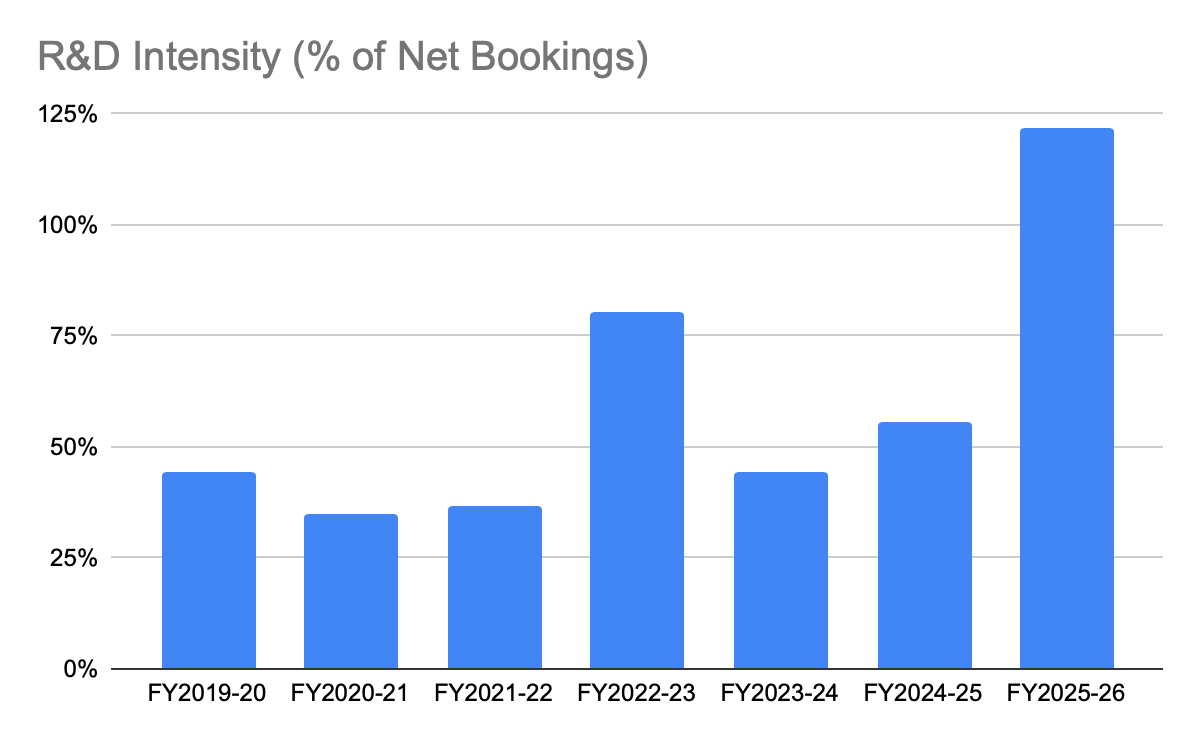
Ubisoft R&D Intensity (% of Net Bookings) (2020-2026)
For a mature AAA publisher, R&D intensity in the roughly 30–45% range is generally manageable across a multi-year cycle, 40-60% range during heavy development years of flagship titles. Any year above 60% is a red flag, based on comp AAA publishers’ filings, anything above 100% is a massive red flag and means extreme cost cutting is needed.
Free Cash Flow showed there is a problem, Net Bookings showed that Ubisoft’s hit rate is fairly volatile, R&D Intensity showed development costs spike in red flag territory, there is one final metric we need to see to take this investigation home.
Operating Margin
With Net Bookings showing a volatile performance and R&D showing red flag spikes, let’s look at the profit of the topline revenue given the expenses. For a video game publisher, Operating Margin is the profit remains from each dollar of revenue after taking into account operating expenses (cost of sales, R&D, marketing, G&A, IT, amortization, and impairments).
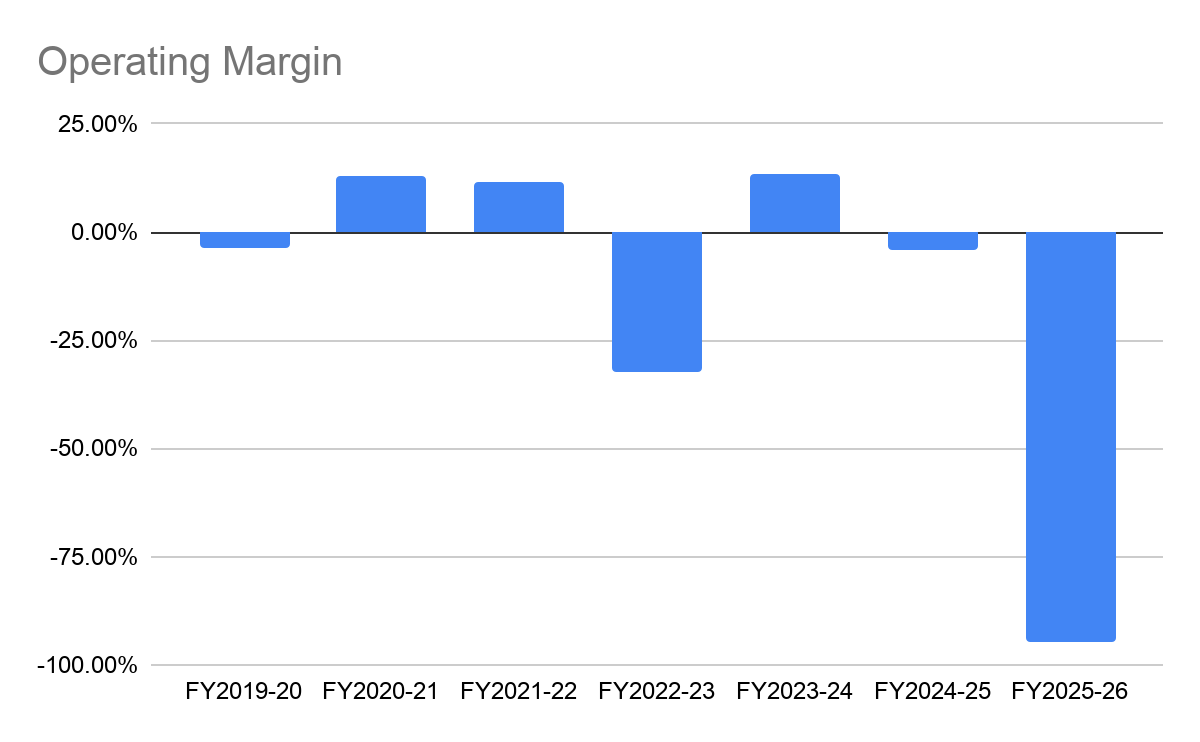
Adjusted Operating Margin (% of Net Bookings) (2020-2026)
Ubisoft’s cost of development and write downs from low performing games are too much for the revenue it’s generating. The picture is complete.
The Full Story
Net Bookings are volatile and too dependent on hits. R&D Intensity is high with two massive red flag years. Operating Margin is negative 4 out of 7 years, with two massive red flag years. This looks like a regular AAA studio with a bad year and a really bad year. But that doesn’t explain the historic market cap dive we started the investigation with.
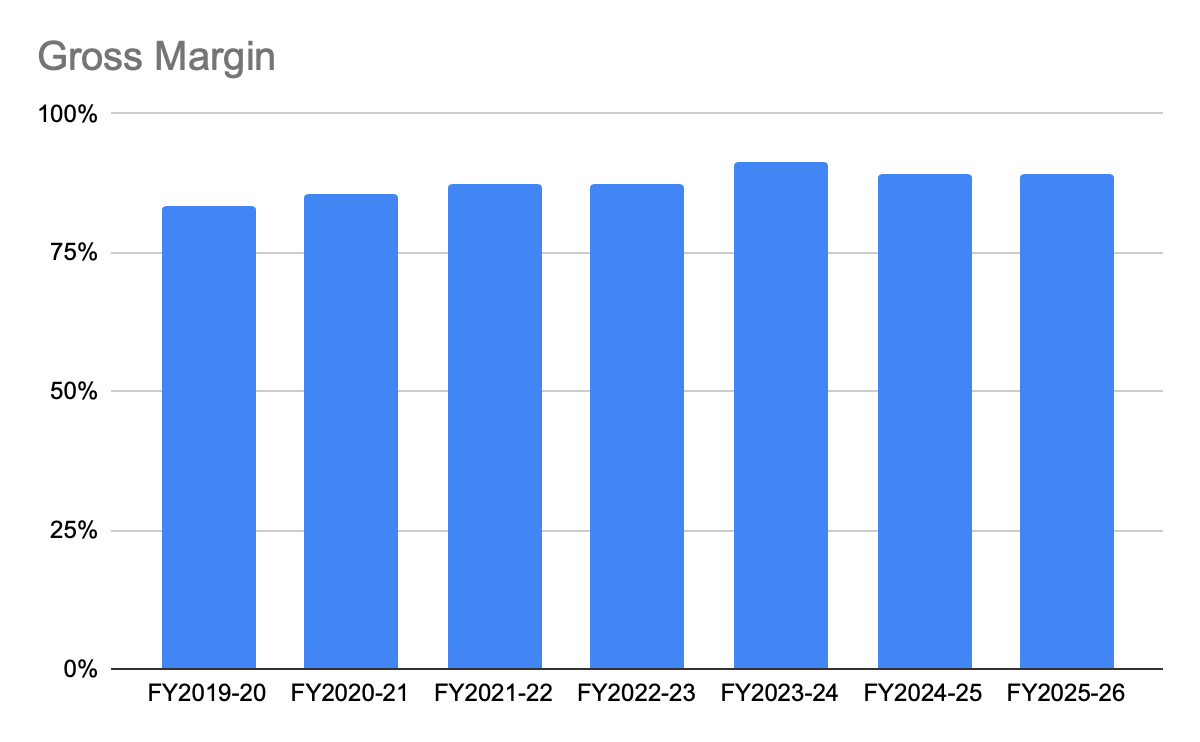
Gross Margin (% of Net Bookings) (2020-2026)
A final piece, Gross Margins, the percent of revenue remaining after development and distribution costs, shows the problem isn’t how much they sold, it’s the development costs of making games that never shipped or didn’t earn revenue.
Free Cash Flow, our first metric, tells the story. Because development cost is capitalized, booked as an asset and expensed slowly through amortization, operating income can look respectable in a year the company is actually burning cash. Free Cash Flow can’t be smoothed that way because it measures cash moving in and out of the business.
Ubisoft’s released games are healthy, Ubisoft’s cost structure and green-light discipline are not.
The market is rewarding this with a revenue multiple around 0.5, a fraction of the typical 2 to 3 historic multiple for public AAA studios and publishers. This means the market expects Ubisoft to continue its decline.
What Can Ubisoft Do?
The amount of video games with 9-figure development budgets is declining. Audience fragmentation, blackhole live service games, market saturation, and the lack of creative risks a mass-appeal game must adhere to limit how many AAA game releases the industry can support. This is on top of the fact that most of Ubisoft’s franchises are decades old with double digit titles under their belt.
But Ubisoft is still sitting on an amazing opportunity. Ubisoft has an army of talented, competent game developers in its midst. Ubisoft’s main force is in Montreal, where not only does it enjoy lower wages than major big cities in the United States, but the city of Montreal gives various tax credits and financial incentives to operate in the city.
As Ubisoft’s AAA cost base per hit rate is no longer delivering, here are the armchair-CEO big brain moves:
Greenlight lower dev costs, higher ROI games: such as roguelikes, competitive games, and anything with high asset reuse and skill mastery as progression
Target new audiences: where are the new IPs for Gen Z, Gen Alpha, and younger. Just Dance and Rabbids are both 2 decades old
Create a pipeline for the next generation: identify key talent under 40 and get them behind a game in a directing position as fast as possible
Use live service selectively and from the start: if you want recurring revenue, integrate the live-service elements into the game design, not as single player IAPs
All of this is easier said than done of course. A structural shift from making AAA games in very specific genres to becoming a AAA publisher for the 2020s requires a complete cultural makeover. That said, the new creative house model will be an interesting management decision to see play out.
Thank you, your clearly written post is very informative. I would love to read more about your take on U. I would like to know how the tax credit for qualified labour (up to 37% of salary) play in the calculation of R&D expenses. Is it possible that the actual R&D expenses are even higher that what you are showing here.