


As a lifelong anime fan, I always saw tentpole manga properties as these cultural touchstones, Dragon Ball’s Goku is recognized across the world and Demon Slayer’s Mugen Train was the highest grossing film of 2020 worldwide, the first time a non-Hollywood film topped worldwide box office sales. These properties transcend print to theatrical movies, merchandise, and fan-ran conventions dedicated to manga-based IP. On the other hand, tentpole video games can take decades to develop a transmedia presence. Everyone knows Mario and Pokemon, but the falloff is pretty steep after those two in terms of longterm standalone IP demand outside of video games (though 1995’s Mortal Kombat is truly the definition of a good time).
The easy answer to why I see manga IP as these transmedia behemoths and not video games is that storytelling and world building are core differentiators in manga but not necessarily in games. Manga’s value is in its characters, worlds, vibes, and other storytelling properties whereas video games mostly succeed on game mechanics, game systems, and overall gameplay.
Take gaming’s northstar IP Mario. It’s about an Italian plumber that jumps on sentient mushrooms but also eats other mushrooms to gain powers and traverses pipes to defeat a monstrous turtle. How many Elden Ring players can articulate what the story is or the motivations of its main characters? Video games don’t need compelling world building as much as they need serviceable vibes.
But there is more to it than just “manga is storytelling and games are immersive experiences”. We need to explore why one industry, mostly centered in Japan, can produce global transmedia hits and another industry, a worldwide one, fails to convert their hit IP into transmedia powerhouses. To start, let’s take a look at transmedia hit rate in both industries.
What is a Hit?
A hit IP can mean different things to different industries. Lethal Company is a hit video game, selling an estimated 10 to 15 million copies. Kingdom is a hit manga, selling over 120 million copies across over 80 volumes. Are either a hit IP that transcend their original medium?
For this article, I want to focus on both relative scale within their respective industries, to identify industry hits, and compare that with transmedia performance outside of its home medium. Does the IP have the scale and pull without its main industry productline?
For scope sake, I am constraining the exercise to IP that first arrived within the last 10 years, because the video game industry that produced Super Mario Bros and the manga industry that produced Dragon Ball are both wildly different than their modern counterparts.
Here are the rules:
The IP’s first release must be within the last 10 years
For manga, a hit has 20M+ manga copies in circulation
For video games, a hit has 10M+ copies sold or 25M+ active/lifetime users
To constitute as a transmedia success, there is proven IP value and demand outside of the original medium
The Industry Hits
Because manga volumes sales are easier to track, we have a clear list of hits within the last 10 years.
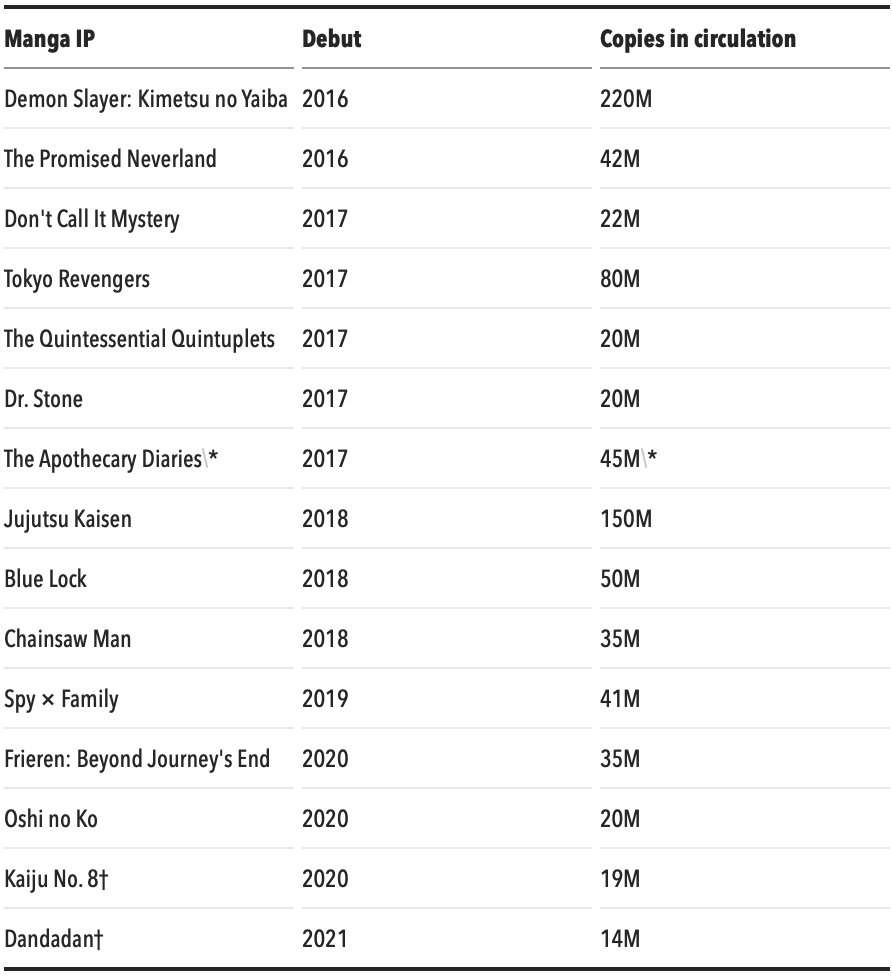
* originated as a light novel in 2011, 45M includes manga and light novel sales
† both were below the 20M during last reported sales but likely over 20M as of September 2026
Video games become a bit trickier. Not only is it difficult to get accurate physical and digital sales on premium titles, it is even more difficult to get accurate revenue or unique user counts on live service games.
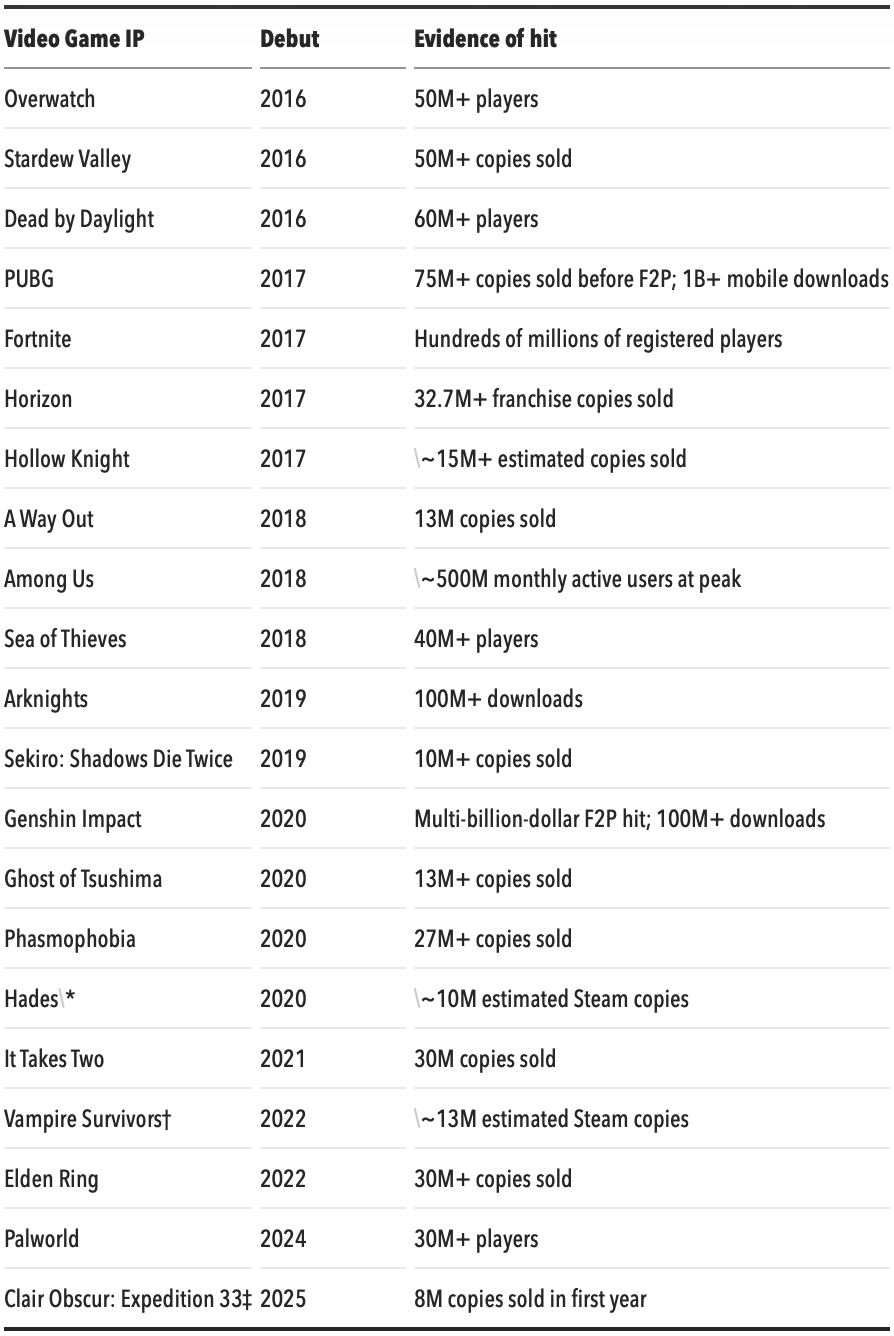
* based on third party Steam estimates
† based on third party steam estimates
‡ under 10M copies sold during last reported sales but likely over 10M as of September 2026
Excluded titles: Escape from Tarkov (lacking reported numbers), Honkai: Star Rail (Honkai is not a new IP), Balatro (5M+ officially reported copies)
The lists are widely different in size, scale, and diversity. You’re probably already concluding that I proved my thoughts on IP creation wrong and clearly video games, with their widespread penetration and industry scale, destroy the meager Japanese-centric manga industry. But now let’s see how these IP fare without their media home base. Would Elden Ring have market value to someone who hasn’t played the original game?
What is a Transmedia Hit?
A hit video game or manga is one thing, but can that IP deliver hit-like status in other forms of media or entertainment? Transmedia can include tv shows, movies, live action adaptations, merchandise, licensing, tabletop games, and other consumer products. A manga like Oshi no Ko can be a massive hit without having any impact outside of manga. Sea of Thieves can have tens of millions of players explore its world without anyone caring about the IP outside of games.
To measure whether an IP is a transmedia hit, I’ll use the follow criteria:
Demonstrated consumer demand outside the original medium
Transmedia products span multiple formats
Owner-funded promotional content alone is insufficient
Attempts or announcements do not contribute
An announced video game or manga film adaptation doesn’t score transmedia credit. Having plushies for your main character on Amazon isn’t a demonstration of merchandise success. Licensing needs to be funded by third parties, not the parent company of the IP holder.
The Transmedia Hits
Manga again has a clear and easy to measure transmedia presence with receiving an anime adaptation being the most common first step to transmedia success.
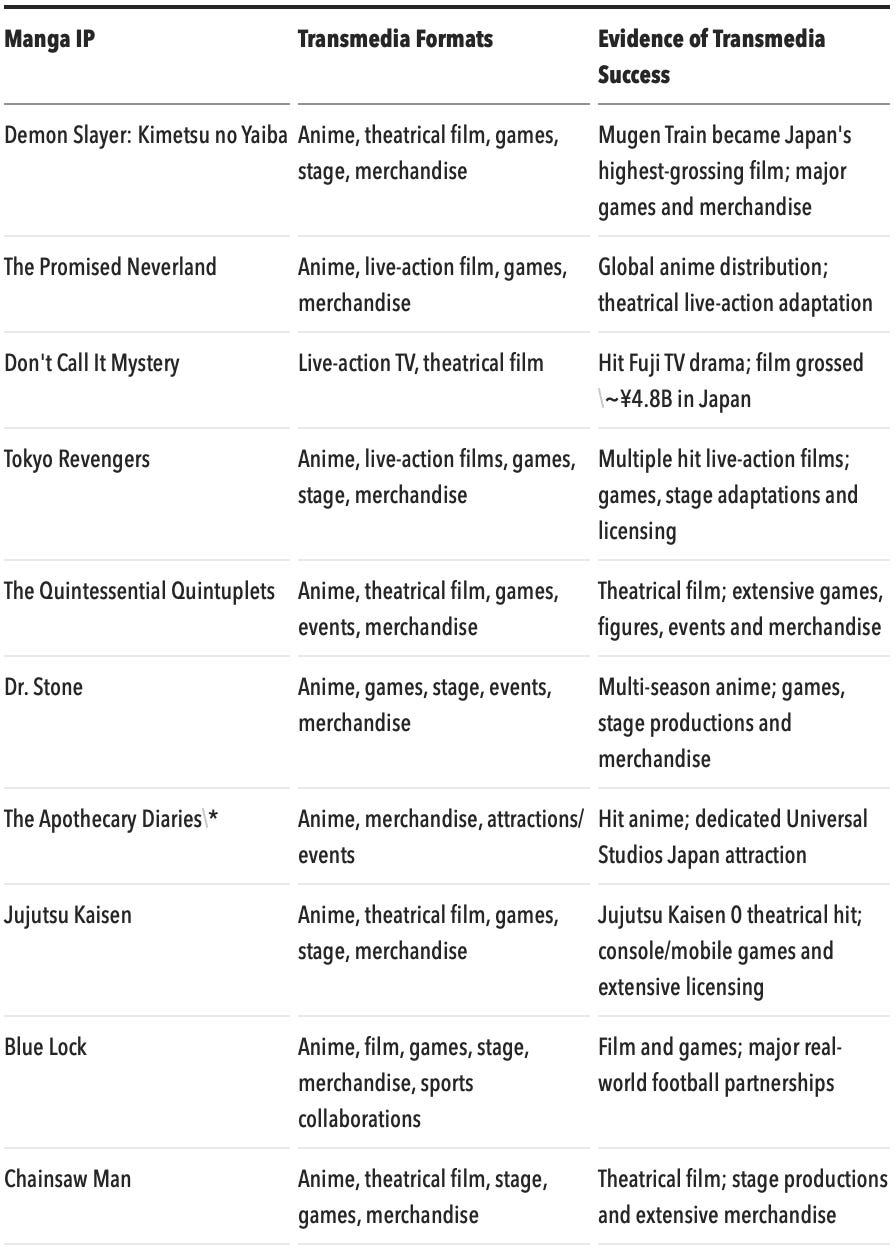
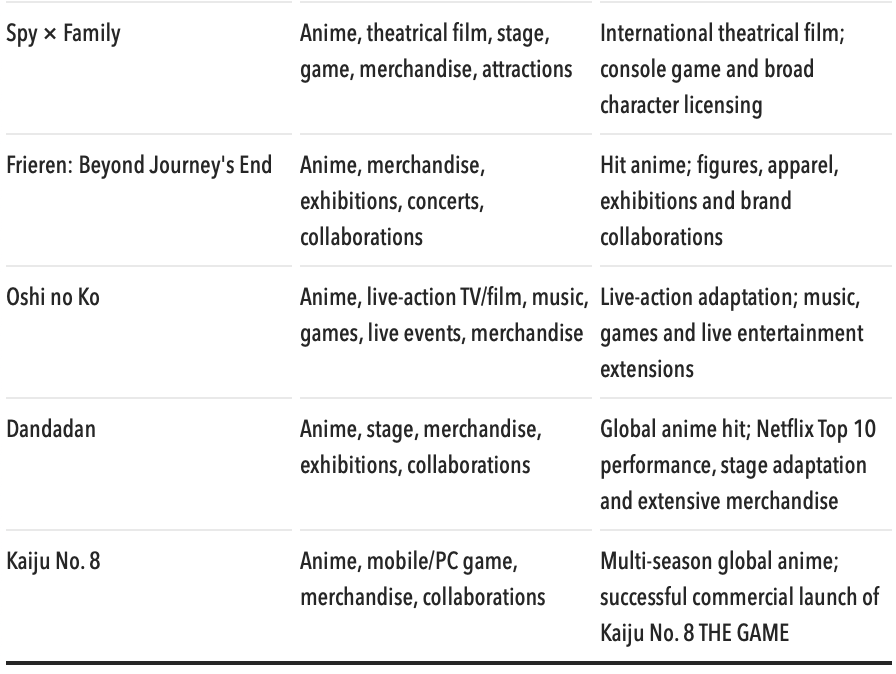
*The Apothecary Diaries originated as a web/light novel series, not manga.
The video game hit to transmedia hit rate is much smaller than manga. Remember we are looking at meaningful revenue where licensing is not funded by the IP holder.
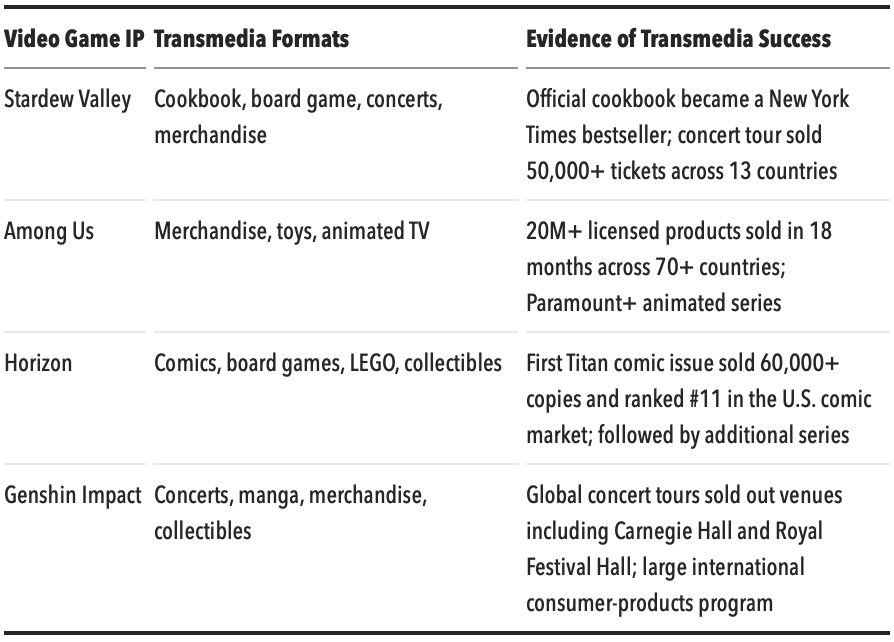
Notable omissions:
Overwatch — extensive external licensing through LEGO, Hasbro, Funko, Uniqlo and others, but limited public evidence that the non-game products themselves became major hits. Blizzard-funded animated shorts are marketing, not independent transmedia validation.
Fortnite — LEGO Fortnite and Rocket Racing are still video games. Comics and merchandise exist, but there is limited evidence that Fortnite itself has become a major standalone non-game media property.
Dead by Daylight — primarily imports outside IP into its game. The announced film has not yet demonstrated consumer demand outside games.
Sea of Thieves — novels, comics, tabletop games and merchandise exist, but there is little public evidence that any became significant commercial hits.
Palworld — Sony Music/Aniplex/Pocketpair created a JV to expand the IP, but that demonstrates investment in transmedia potential rather than proven transmedia success.
Elden Ring — manga, merchandise, tabletop products and an upcoming film demonstrate significant expansion efforts, but the largest adaptations have not yet produced enough independent consumer-performance evidence.
Arknights — successful anime and extensive merchandise exist, but public performance data is weak enough that I would keep it outside the strict list.
PUBG — Krafton has produced webtoons, films and other PUBG Universe content, but none has demonstrated comparable breakout demand outside the games.
Manga has 15 out of 15 of their hits in the last decade becoming transmedia hits, a perfect score.
Video games is sitting at a paltry 4 out of 21 hits in the last decade becoming transmedia hits.
Why Does Manga Have a Higher Transmedia Hit Rate?
A hit IP creates multiple onramps into that universe. A hit anime increases manga sales. A hit Netflix show creates a flood of new players. Transmedia is the key to an IP that transcends major releases within its main medium.
There are 3 industry tailwinds that make manga an IP producing powerhouse and are lacking in video games:
The Manga Series Pipeline Ensures Only Proven IP Survive
For a manga series to reach mainstay status in one of the popular weekly publications, it already had to survive multiple stage gates where it competed against other budding series and titles. Only when a manga series has demonstrated staying power does it receive third party interest in anime adaptations, films, merchandise, licensing, etc.
The manga industry is set up as a giant funnel where it maximizes dollar per new IP attempts at the bottom, and only provides top editor support, marketing pushes, and third party BD once a new IP is a proven hit. A common pipeline is:
Jump Rookie - digital platform where amateurs can garner attention by showing their works
One-shots - annual events where top publications let authors compete by submitting one chapter in hopes of serialization
Series trial - the best one-shots are given a trial run of a series slot in a periodic publication, generally 15 to 25 chapters
Mainstay - once proven as a consistent driver of readers, as series receives a mainstay slot in a publication
Transmedia - the biggest flagship series will then receive business development support for anime adaptations, merch, music, etc.
Each step is quantitatively measured by reader surveys and reading data on digital platforms. This gives manga one of the highest IP attempts per dollar of any entertainment industry. Editorial investment is staged and only the strongest series reach the prestigious heights of being the cover image for a publication. In manga, the expensive decision of investing in a high cost anime or film is last in the pipeline and only after the underlying IP has been completely de-risked. Contrast to video games where the most expensive decision is first, to fund an 8- or 9-figure development budget.
Shonen Jump+ publishes more than 200 one-shots per year. KADOKAWA creates more than 6,000 new publishing IPs annually, which ultimately feed roughly 60 animation projects. The creator of Naruto, Masashi Kishimoto, had their follow-up series, Samurai 8, dropped before it reached 50 chapters; even the creator of one of history’s biggest manga franchises wasn’t protected from the funnel when his next property underperformed.
A Hit Manga Proves the IP’s Value
A hit manga series validates the characters, world, story, and visual identity, lowering the risk of funding products in other media with those same characters and worlds. Because of this, a hit manga materially de-risks anime adaptation. Fans fall in love with the portable part of the IP.
Each additional hit manga series provides incremental revenue for its publishers. This leads to portfolio turnover where there is a constant need to find the next hit manga series.
Video games are the opposite where a successful game validates the gameplay, progression, systems, and art direction. Great gameplay doesn’t lower the risk of funding a film for the game’s IP.
Manga Transmedia is a Flywheel Not Funnel
Hit manga series grow revenue outward through anime, film, merchandise, licensing, music, etc. Maximizing lifetime value for a fan is a diversity play across many mediums. Publishers are well aware of this and have transmedia committees ready to support expansion horizontally. There is an entire ecosystem of third parties who solicit publishers and compete for adaptation rights and merchandising for hit manga series.
Transmedia properties can then supercharge manga volume sales. Oricon estimated cumulative Demon Slayer manga sales at roughly 3.15M before the anime versus 20.4M roughly eight months later after the first season aired, a 6.5× increase. This creates a flywheel where a fan discovers an IP from one gateway (manga, anime, licensed games) that leads to purchases in the other transmedia products.
In video games transmedia is often funded by the publisher and seen as a top of the funnel marketing expense. Riot funded Arcane. Blizzard funded Overwatch shorts. Krafton has produced Webtoons in the PUBG universe. Video games instead turn inward with DLC, content packs, IAPs, ports, and sequels to drive lifetime value for players.
What Can Games Learn from Manga?
Games don’t have a shortage of successful new IP. They have a system that commits huge amounts of capital before market validation and then has difficulty determining how much of a hit belongs to the game versus the IP.
The solution is to make AAA the reward for a proven IP, not the mechanism for discovering proven IP. Video game publishers need to create an analogous pipeline to identify talent, give them a laddered production environment to prove further investment, and create quantitative measurements to graduate from levels in the ladder.
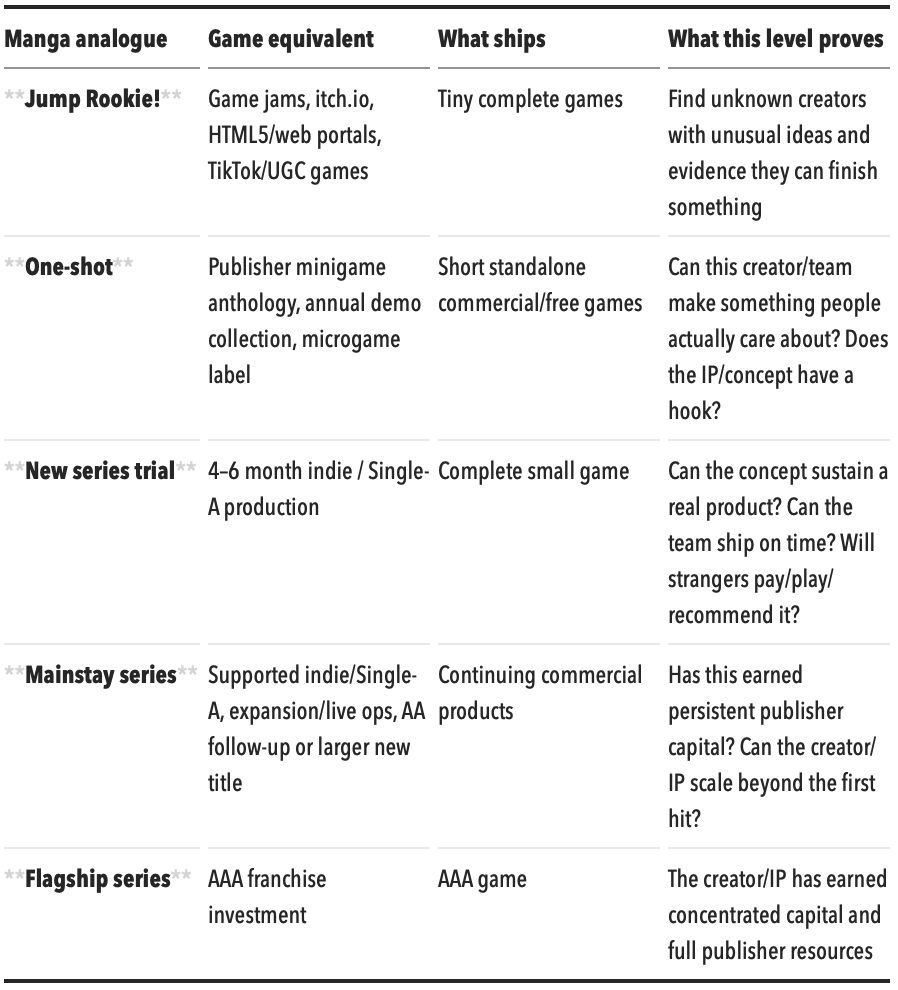
Currently, video game publishers use internal signals to develop, stage gate, and greenlight AAA games today. This transforms the traditional greenlight process into a manga-inspired process supported by external market validation.
Don’t assume 20M players means film demand. Test whether characters and worlds travel through progressively larger non-game products. Let consumer demand earn the television series or film just as it earned the AAA game.
At the One-Shot level, you can start observing: Do people remember/name the characters? Is there fan art? Do players want lore/story beyond the short game?
At the New Series Trial, you have real commercial feedback: character-specific engagement, fan art/cosplay, lore/wiki consumption, and initial merch tests.
By Mainstay, you can test the transmedia waters with: figures/plushies/apparel, comics/manga, short animations, tabletop ports, and pop-up/events.
This reverses the risk profile of AAA investment by letting consumers, not greenlight committees, provide the evidence. The same process that determines which games deserve greater investment can identify which characters and worlds deserve transmedia investment.
Manga publishers don’t know which one-shot will become the next Demon Slayer. Instead, the industry tests an enormous number of ideas cheaply, concentrating capital behind the survivors, and then building an ecosystem around the winners. The game industry needs to give more games a cheap way to prove they could become one.