


On Monday Xbox is rumored to be closing or spinning off Ninja Theory, Compulsion Games, Double Fine, Undead Labs, and Arkane Studios, studios behind prestige titles such as the Hellblade and Psychonauts series.
The internet is ablaze with push-back: “Why after you just announced State of Decay 3 and Senua?” and the seminal “Is Xbox cooked?”. But the harder question is did those studio acquisitions move sales in a meaningful way?
Is the Xbox Acquisition Strategy to Blame?
The modern Xbox studio lineup began in 2018 when then CEO Phil Spencer went on a legendary acquisition run acquiring 7 game studios in a year span. By the time Asha Sharma took over, Xbox had ~31 game and support studios that are owned and currently active.
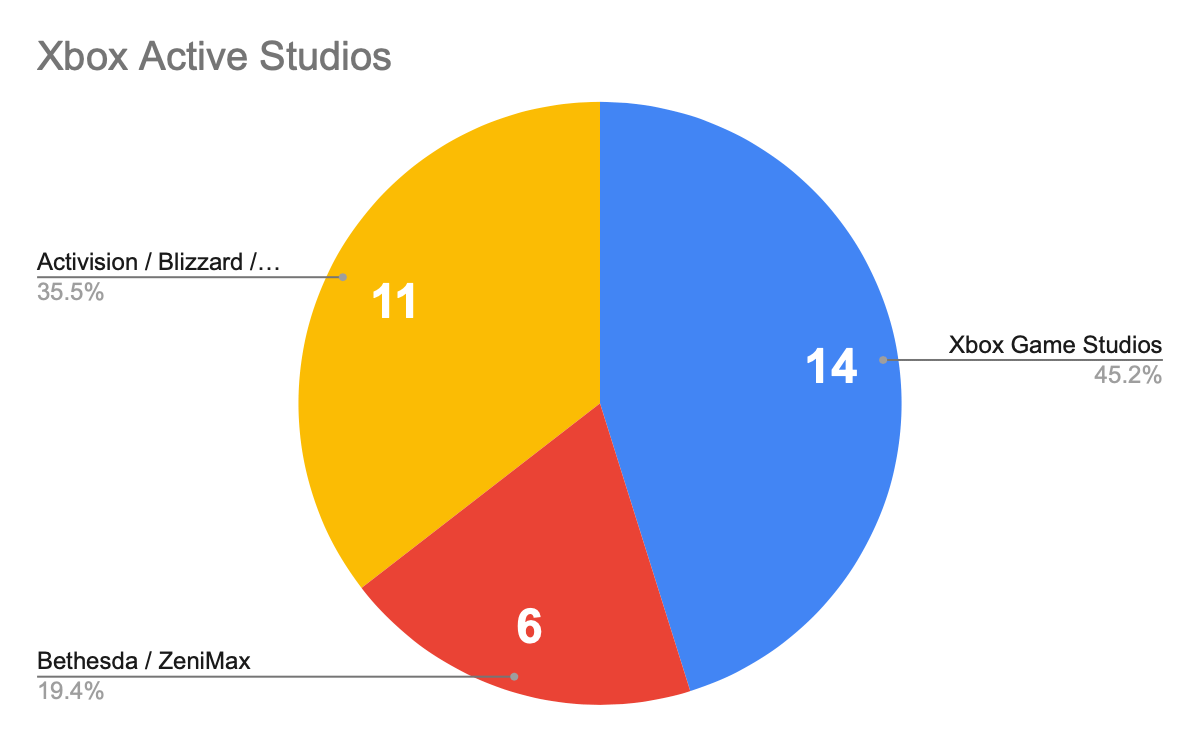
Within this army of recent studios acquisitions, we only know the costs of two:
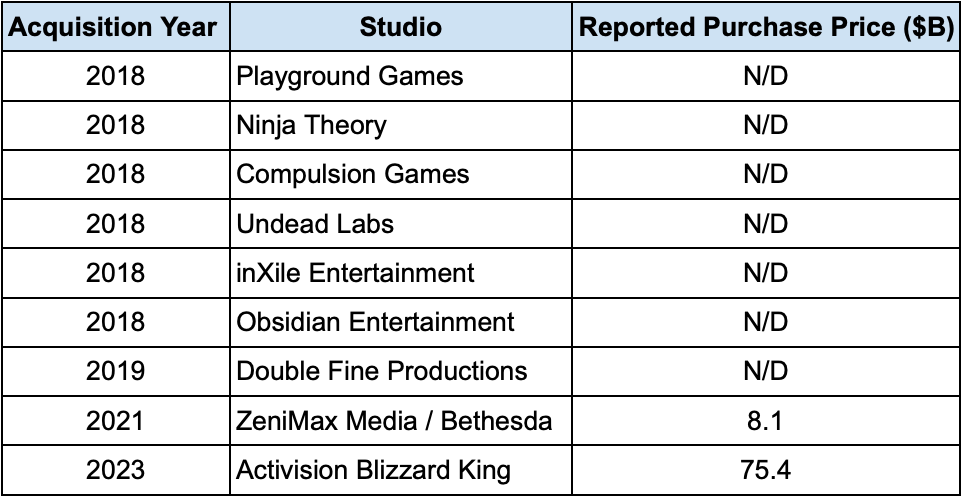
So Microsoft spent $83.5B on disclosed acquisitions, not accounting for the 7 acquired between 2018 and 2019, but did any of these acquisitions meaningfully move sales? Publicly available data for Xbox is scarce as Microsoft only breaks out a few metrics in their 10Qs and 10Ks for Xbox. We have:
Annual Gaming Revenue
Overall Gaming Revenue Growth %
Xbox Content & Services / Software & Services Growth %
Xbox Hardware Revenue Growth %
From this we need to investigate
Are the acquisitions driving topline revenue?
Are the acquisitions driving hardware sales?
Are the acquisitions driving content and services sales?
Did These Acquisitions Drive Sales?
Let’s start with the most important scorecard, Annual Gaming Revenue.
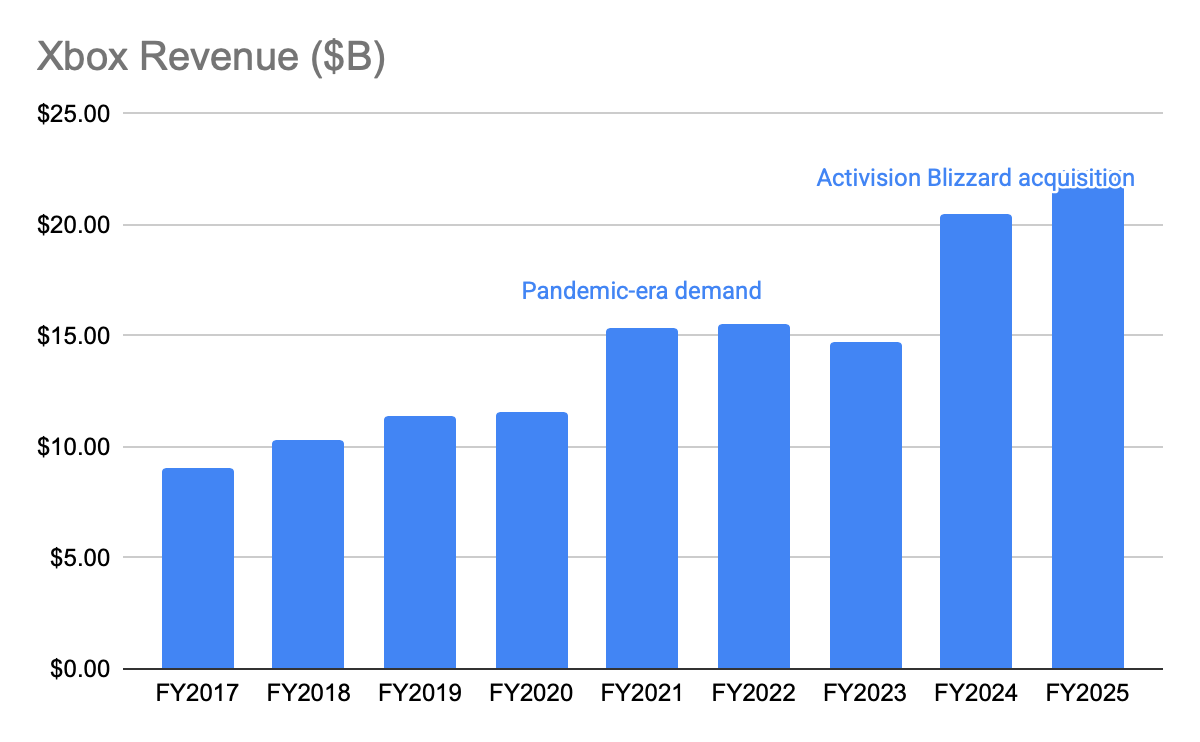
Xbox Annual Gaming Revenue, FY2017-FY2025
We clearly see two major jumps in annual revenue: the COVID-19 bump and the Activision acquisition. Unfortunately, public disclosures do not show a visible revenue inflection tied to Xbox’s smaller prestige acquisitions. That does not prove those studios generated no value; it shows Microsoft does not disclose enough data to demonstrate that their value was material at Xbox’s scale.
Here are the Year-over-Year (YoY) changes broken out for clearer growth signals:
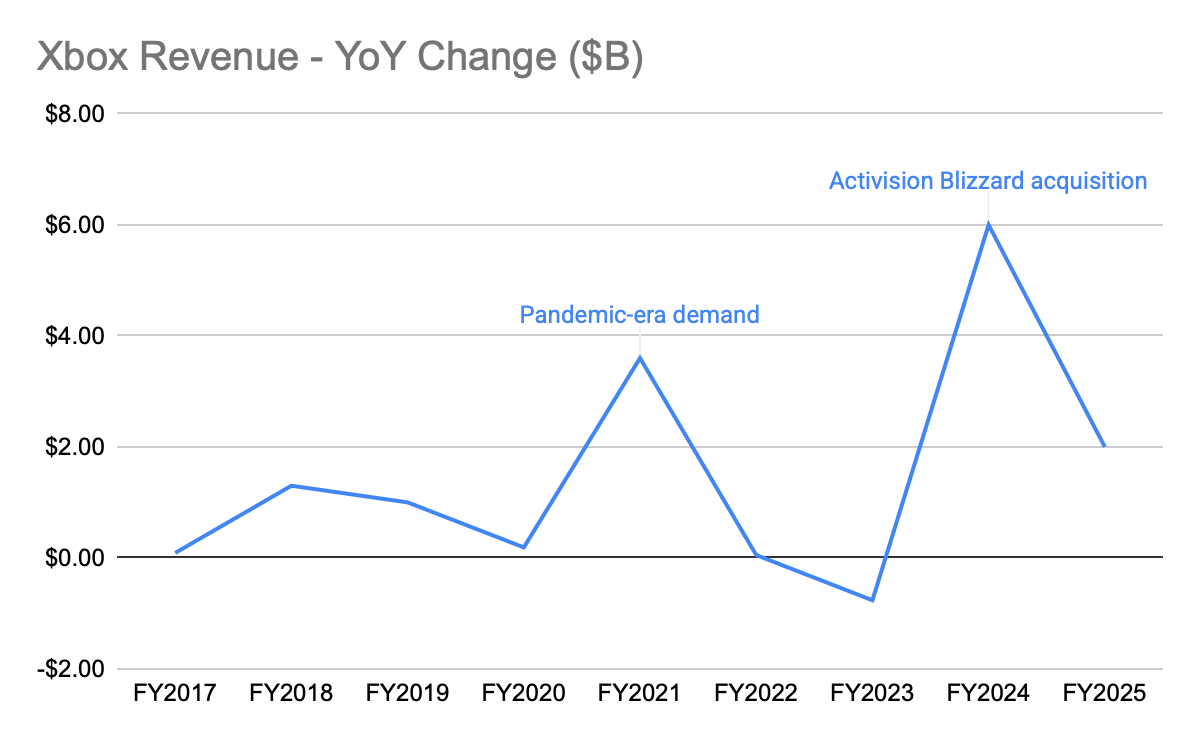
Xbox Annual Gaming Revenue - YoY Change, FY2017-FY2025
Psychonauts 2 and Hellblade II may be award-nominated and fan-favorite darlings, but we can’t see in the disclosed data to show whether they generated meaningful Game Pass retention, premium sales, or franchise value at Xbox scale. That is the problem: a portfolio this large requires a measurement system capable of proving why each studio deserves another full development cycle.
So maybe Undead Labs, Obsidian Entertainment, and other acquisitions didn’t drive obvious topline sales, but they could have expanded the Xbox base through hardware sales by being the prestigious exclusive titles only available on an Xbox?
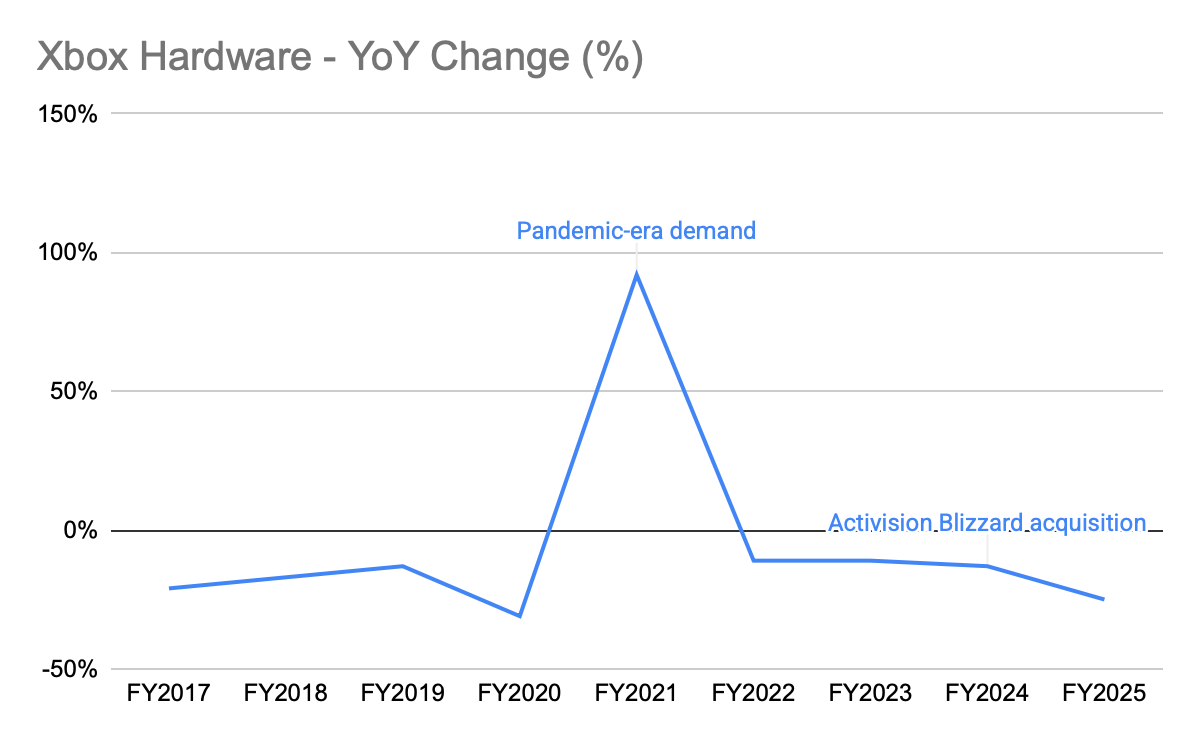
Xbox Hardware Revenue Growth, FY2017-FY2025
Very cleanly we can see Xbox hardware sales have been on a YoY decline outside of the anomaly demand that was the lockdown period. We should note Activision’s major titles were kept cross-platform as a revenue and regulatory play. Hardware revenue is a weak signal for Xbox’s broader user base, but it is a strong signal that first-party content has not restored console-sales momentum.
That’s fine, one might say, because Xbox’s real plan was Game Pass subscriptions. It was the gaming version of Netflix: acquire a bunch of attractive exclusive content across niches and subsidize the cost with each additional subscriber. Once the subscription base hits scale, rake in the profits.
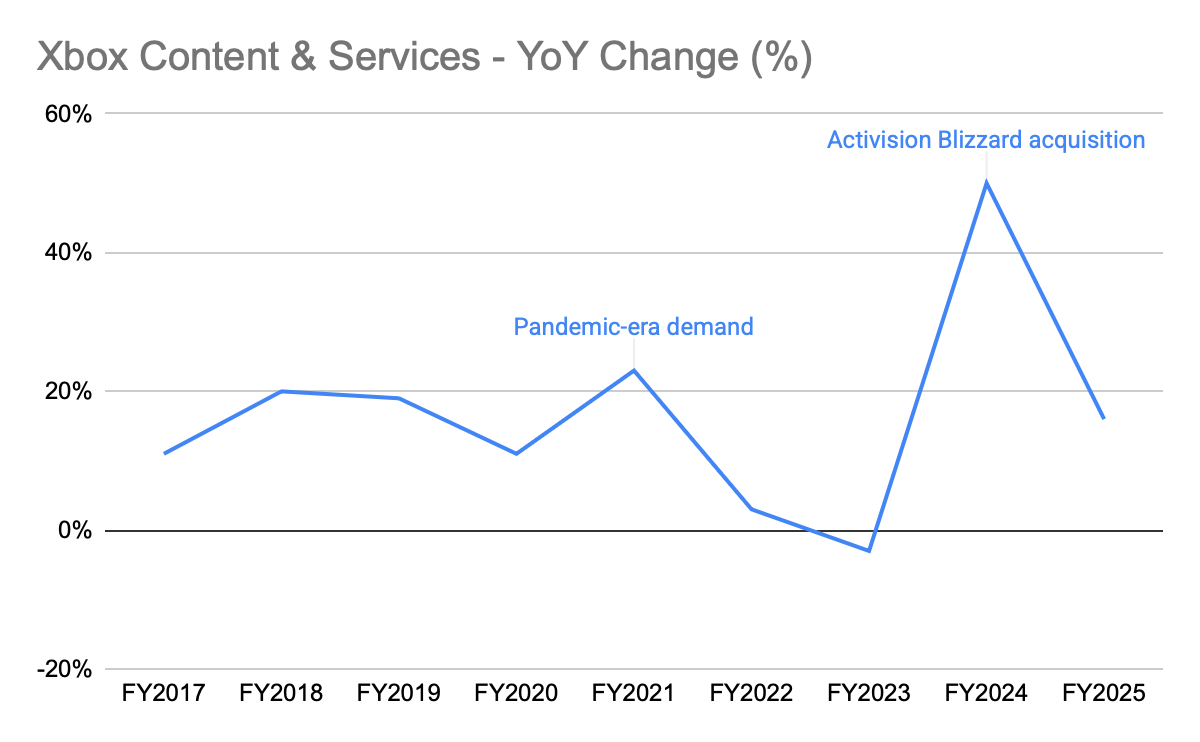
Xbox Content & Services Revenue Growth, FY2017-FY2025
Unfortunately Game Pass revenue is tied into game sales, in-app purchases, and other service fees such as Xbox Live. Xbox Content & Services saw great growth until a post-lockdown slump. Then it was juiced by the Activision acquisition only to be immediately followed by a decline.
If the 3% accountability margin CEO Asha Sharma reported is accurate, it suggests Xbox management believes the division’s current return on profile is inadequate. But because Microsoft has not disclosed the metric’s formula, it should be treated as an internal management signal not as a substitute for operating margin or free cash flow.
So All Those Acquisitions Turned Out Poorly?
Xbox acquired multiple top studios for a disclosed $83.5B, with 7 of those studios acquired for an undisclosed amount. Even if those studios joined Xbox at the cost of free, they have overhead costs such as facilities, marketing, distribution, and administration on top of the R&D and development costs, such as employee payroll, of producing new games.
Previous Xbox leadership acquired scale faster than it created an operating model capable of generating returns from that scale. The reported closure and spinout discussions suggest Xbox does not believe every acquired studio has a sufficiently compelling forward case at its current cost base.
New leadership is determining which studios are valuable enough to retain inside Microsoft. Currently Xbox Game Studios is a collection of:
live-service businesses
mobile businesses
premium-console teams
support studios
prestige creative studios
A studio can be creatively excellent and still not deserve permanent capital allocation inside a company with Microsoft’s alternatives. CEO Sharma’s rumored target accountability margin is 30%, if a studio isn’t contributing towards that goal it needs to be assessed for redundancy.
The original strategy of prestige video game exclusives was to drive Game Pass subscriptions but it’s safe to assume Xbox is moving away from a Game Pass at scale strategy. Now prestige studios need to justify themselves through a broader commercial case: premium sales across platforms, Game Pass retention, catalog value, franchise potential, or strategic differentiation. Console exclusivity alone is no longer enough.
Capital spent on acquisitions must earn a return, not merely produce revenue.
What is the Future of Xbox Game Studios?
CEO Asha Sharma must decide on a new strategy going forward. New hardware is incoming, the current install base is disappointing, and the stable of studios aren’t producing the measurable ROI required at the Microsoft scale. If the 3% accountability margin is true, Sharma has an optimization journey ahead of them to reach the rumored 30% target.
On the other hand, gutting your darling prestige studios in the name of margins has its limit. Xbox has to mean something. When a player sees an Xbox they need to conjure images of the platform home of the games they want to play. Xbox needs prestige studios, they don’t need them producing games in the red. Playstation has demonstrated that prestige studios such as Naughty Dog can drive hardware sales. There has to be a middle ground between dropping studios after hype game announcements and letting studios run comfortably in the red. New management, lower budgets, bonuses tied to financial goals, and giving hungry developers a shot at the reins are all on the table.
One thing is for sure, Xbox is in need of a serious shakeup. CEO Sharma dropping Ninja Theory, Compulsion Games, Double Fine, Undead Labs, and Arkane Studios sends a message that nothing in the Spencer era of Xbox is sacred. We’ll have to see what Xbox means in the second half of the 2020s.